
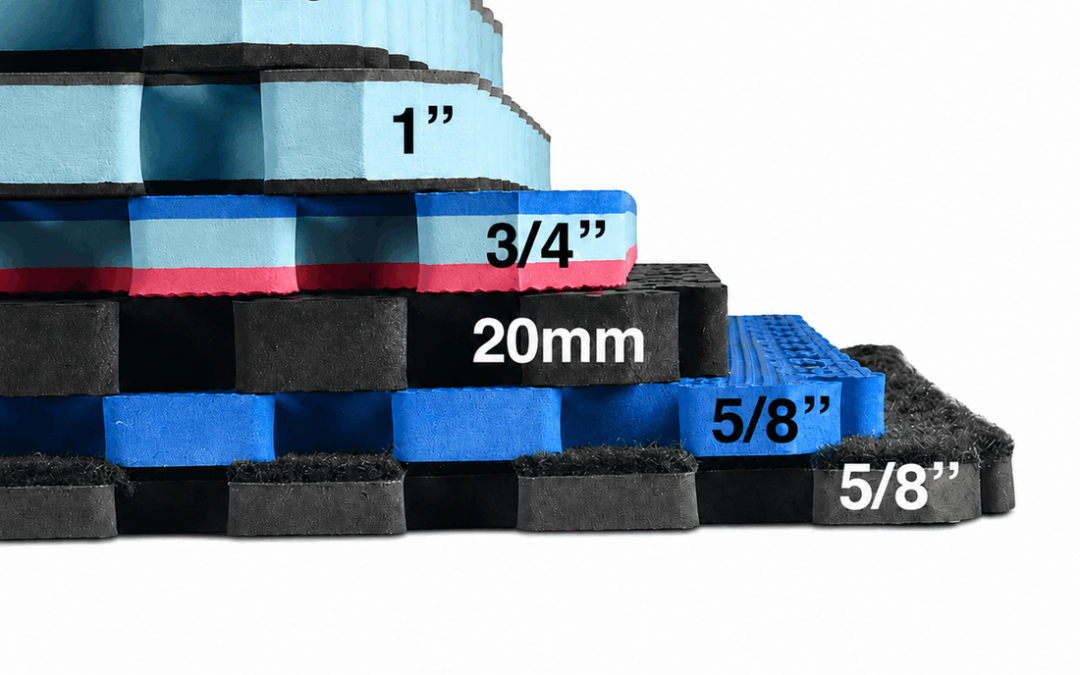
This EVA foam mat thickness guide explains how mat depth affects cushioning, floor height, stability and suitability for different indoor areas. A 12mm foam mat can be a practical option for playrooms, crèches, classrooms, stretching zones and light home activities, but the best thickness still depends on how the space will be used. To compare available soft flooring products, sizes and applications, browse our EVA Foam Mats collection.
What Thickness EVA Foam Mats Do You Need?
For many dry indoor comfort areas, a 12mm EVA foam mat provides a useful balance between cushioning, manageable floor height and lightweight installation. It can suit children’s playrooms, crèches, reading corners, home activity rooms, stretching and light exercise. Thinner mats may suit temporary light-duty coverage, while thicker foam can provide a deeper cushioned feel. However, thickness alone does not determine durability, equipment support or suitability for playground fall protection.
Thinner foam mats
Best considered for temporary protection, short-duration activities and areas where only limited cushioning is required.
Balanced indoor comfort
A practical middle option for playrooms, classrooms, crèches, stretching and other light floor-based activities.
Deeper cushioning
May provide a softer floor feel, but finished height, firmness, furniture pressure and intended use must still be checked.
Why EVA Foam Mat Thickness Matters
Thickness is one of the first specifications people notice when comparing foam floor tiles. It influences how the floor feels, how high it sits above the existing surface and how it responds when people sit, crawl, kneel, stretch or exercise on it.
A very thin foam layer may soften the immediate feel of a hard floor without creating substantial cushioning. A thicker tile normally creates more separation between the user and the permanent floor, but it can also raise the finished surface and affect doors, cupboards, furniture and transitions to nearby flooring.
The ideal thickness therefore depends on the application rather than one universal number. A child’s reading corner, temporary exhibition floor and home stretching area do not experience the same movement, pressure or daily traffic.
Thickness must also be considered together with foam density, hardness, surface texture, tile size and joint construction. Two products with the same stated thickness may not feel or perform exactly the same because the internal construction can differ.
This is why a reliable EVA foam mat thickness guide should not simply recommend the thickest product available. The aim is to choose enough cushioning for the intended activity while maintaining a stable, practical and manageable floor.
Is 12mm a Good EVA Foam Mat Thickness?
A 12mm EVA foam mat is a versatile option for many indoor comfort applications. It provides more separation from a hard floor than a very thin surface covering while remaining lightweight enough for straightforward handling and loose-lay installation.
For children’s playrooms and crèches, 12mm mats can help make ceramic tiles, concrete, laminate and other hard surfaces feel softer during sitting, crawling, reading and toy-based activities. The mats can cover the whole activity room or create a selected soft play section.
In home activity areas, the same thickness can be suitable for stretching, yoga preparation, mobility exercises and light bodyweight movement. It should not automatically be used beneath heavy machines, loaded weight racks or equipment with narrow pressure points.
A 12mm mat can also be useful in temporary spaces because the tiles are normally easier to lift, carry and rearrange than dense heavy-duty flooring. This helps when a room must alternate between exercise, play, study or general family use.
12mm does not mean suitable for every application
A 12mm mat can provide comfortable indoor cushioning, but the thickness alone does not prove that the product can support heavy equipment, absorb dropped weights or protect against falls from raised playground structures. Always match the product’s stated use to the activity.
Where 12mm Foam Mats Work Best
Suitable light indoor applications
- Children’s bedrooms and indoor playrooms.
- Crèche and daycare activity areas.
- Classroom reading corners.
- Supervised baby crawling zones.
- Home stretching and mobility spaces.
- Yoga and Pilates preparation areas.
- Temporary soft flooring sections.
- Indoor recreation rooms.
- Quiet sensory spaces.
- Light bodyweight exercise areas.
Applications requiring another solution
- Heavy weightlifting and dropped-weight zones.
- Large exercise machines and loaded racks.
- Commercial gyms with demanding daily traffic.
- Outdoor areas exposed to rain or sunlight.
- Wet rooms containing standing water.
- Garages, workshops and vehicle areas.
- Industrial spaces containing machinery.
- Sharp equipment and tool areas.
- Raised playground-equipment fall zones.
- Areas requiring certified impact surfacing.
The main strength of 12mm EVA foam is comfort during light indoor use. When the area requires strength, stability or resistance to concentrated loads, thicker foam is not necessarily the correct answer. A denser rubber or specialist flooring product may be more appropriate.
Thinner EVA Foam Mats: When Are They Suitable?
Thinner foam mats are often selected when low weight, easy storage and a smaller change in floor height are the main priorities. They may be useful for temporary layouts, short events, basic surface separation or light activities where deep cushioning is not required.
Because they create a lower profile, thinner mats may fit more easily beneath doors and low cupboards. They may also produce a less noticeable transition between the foam section and surrounding flooring.
However, reducing thickness generally reduces the amount of material between the user and the hard substrate. The floor may therefore feel firmer during kneeling, crawling or longer sessions close to the ground.
Thinner mats may also show the profile of an uneven substrate more easily. Small ridges, tile joints and surface imperfections can remain noticeable if the underlying floor has not been prepared properly.
Choose thinner foam when the application genuinely requires light temporary coverage—not simply because it is easier to store. For playrooms, crèches and longer floor-based activities, a 12mm option may provide a more comfortable balance.
Do You Need EVA Foam Mats Thicker Than 12mm?
Thicker EVA tiles may be preferred when a deeper cushioned feel is important. They can create more separation from hard concrete or tiled floors and may feel more comfortable during extended kneeling, sitting or floor-level activities.
Nevertheless, greater thickness introduces additional planning considerations. A thick tile raises the finished surface, which may interfere with doors, cupboards, floor vents and transitions between rooms.
Soft thick foam may also compress beneath furniture or equipment. Increasing thickness does not automatically create a stronger base. In some cases, a thicker soft product may allow narrow furniture legs to sink more noticeably than a firmer product.
Before choosing foam thicker than 12mm, ask:
- Will the extra cushioning improve the intended activity?
- Will doors still open over the completed floor?
- Will furniture or equipment stand on the mats?
- Does the product have the correct density and firmness?
- Will the raised perimeter create a walking obstruction?
- Can compatible edging be installed?
- Is the foam approved for the planned environment?
- Would a denser flooring material be more suitable?
A thicker mat should be chosen because it solves a specific comfort requirement, not because the highest number automatically sounds better.
Thickness, Density and Hardness Are Not the Same
Thickness describes the physical depth of the tile from the bottom surface to the top. Density relates to how much material is contained within a given volume, while hardness describes how resistant the surface is to indentation.
These specifications work together. A thick low-density mat may feel very soft and compress easily. A thinner high-density mat may feel firmer and resist pressure more effectively. Neither product is automatically better; they are intended for different uses.
For floor-based play and stretching, a softer feel may be desirable. For equipment stability, too much compression can become a disadvantage. This is why a product should be selected using its complete specification rather than thickness alone.
| Specification | What It Describes | Why It Matters |
|---|---|---|
| Thickness | The vertical depth of the foam tile. | Affects cushioning, finished height and floor transitions. |
| Density | The amount of foam material within a given volume. | Influences weight, structure and resistance to compression. |
| Hardness | How easily the surface can be pressed or indented. | Affects softness, firmness and stability beneath pressure. |
| Tile size | The length and width of each interlocking piece. | Determines the number of joints and coverage per tile. |
| Surface texture | The pattern and finish on top of the mat. | Affects grip, appearance and ease of cleaning. |
| Joint design | The shape and strength of the interlocking edges. | Influences alignment and how well tiles remain connected. |
Choosing EVA Mat Thickness for Kids’ Play Areas
Children often sit, crawl, kneel and play directly on the floor. A suitable foam mat can reduce the cold and hard feel of ceramic tiles, laminate or concrete during ordinary indoor activities.
A 12mm mat can be a practical option for reading, puzzles, building blocks, supervised crawling and general toy-based play. It offers a cushioned surface without creating an excessively high floor in many standard indoor rooms.
Parents and facilities should still inspect the interlocking edges, surface condition and room layout. Loose border strips or damaged pieces should be removed promptly, especially in areas used by younger children.
Foam thickness should also be considered alongside the child’s age and activity. A quiet reading corner experiences different movement from a busy group activity room. Choose according to the most demanding normal use of the space.
For a broader explanation of applications, benefits and differences between soft foam and heavier flooring, read our internal foam mats guide for indoor activity areas.
Choosing EVA Thickness for Crèches and Classrooms
Crèches and classrooms normally require flooring that can support repeated supervised activity while remaining manageable to clean and rearrange. A 12mm EVA mat can help define soft zones for reading, floor learning, story time and quiet play.
The full classroom does not always need to be covered. A selected foam section may be more practical when corridors, doorways and furniture zones require a firmer permanent floor.
Before installation, staff should check:
- The age and number of children using the area.
- The activities planned for the foam section.
- How frequently furniture will be moved.
- The cleaning and inspection routine.
- The position of doors, cupboards and heaters.
- Whether removable edge strips are appropriate.
- Whether the mats can be lifted for deeper cleaning.
- Whether another flooring type is needed in high-traffic zones.
Foam should remain a comfort-focused indoor surface. Busy entrances, kitchens, outdoor playgrounds and equipment zones may require other flooring materials.
Choosing EVA Thickness for Home Gyms
EVA mats can be useful in home gyms where the main activities are stretching, mobility work, yoga, Pilates, warm-ups and controlled bodyweight exercise. A 12mm surface can make a hard floor more comfortable for movements performed while kneeling, sitting or lying down.
The mat should not be selected for heavy gym equipment simply because it is thick. Weight racks, benches, treadmills and machines can create concentrated pressure that compresses soft foam.
Heavy weights should not be dropped onto ordinary EVA comfort mats. A stronger and denser gym flooring system is more appropriate for demanding strength-training sections.
A mixed home gym can use different flooring zones. EVA may cover the stretching section, while rubber or another heavy-duty material supports machines and weight-training equipment.
Home gym planning tip: Choose the floor according to the heaviest activity planned for each zone. Do not place a large machine on soft foam simply because the surrounding area is used for stretching.
Can EVA Thickness Protect Against Playground Falls?
Ordinary indoor EVA foam mats should not automatically be treated as fall-protection surfacing beneath slides, climbing structures, swings or raised platforms. A comfortable 12mm mat and a tested playground-surfacing system are not the same product.
Playground surfacing must be selected according to the equipment, potential fall height, covered use zone, product testing and installation requirements. Simply adding more foam thickness does not prove that a surface can provide the required performance.
Facilities responsible for raised playground equipment can review the external CPSC Public Playground Safety Handbook for broader guidance on protective surfacing, equipment areas and playground planning.
Check documented product suitability
For raised equipment and formal playground fall zones, use a surface with documentation appropriate to the equipment and installation. Do not substitute ordinary indoor comfort mats based only on their thickness.
How to Measure the Required EVA Foam Coverage
After selecting the thickness, calculate how many tiles are required. Measure the length and width of the proposed floor area in metres, then multiply the figures to calculate the square metres.
For example, a play or stretching area measuring 3 metres by 2.4 metres covers 7.2 square metres:
3 m × 2.4 m = 7.2 m²
Check the listed size of each tile and the total coverage supplied by each pack. Do not estimate from a photograph because similar-looking products may use different tile dimensions.
Add a reasonable allowance for irregular room shapes, damaged pieces and future replacement. Keeping several matching spare tiles is useful because a later production batch may have a slightly different shade.
How to Check the Finished Floor Height
The completed floor height is equal to the mat thickness, provided that no additional underlay is used. A 12mm mat will raise the exercise or play surface by approximately 12mm above the permanent floor.
Measure beneath doors
Check the gap between the bottom of the door and the existing floor. The door should still open without rubbing against the completed foam surface.
Check low cupboards
Measure cupboard doors and drawers that open close to the floor. Foam should not prevent them from functioning properly.
Review room transitions
Identify where the foam ends beside tiles, laminate, carpet or another material. The change in height should remain visible and manageable.
Plan the border
Use compatible straight edge pieces where available. Ensure that border strips remain fully connected and do not create loose sections.
Check furniture placement
Avoid positioning heavy cabinets partly on the foam and partly on the permanent floor. Uneven support may make the furniture unstable.
How to Install 12mm Interlocking Foam Mats
Many interlocking EVA mats are designed for straightforward loose-lay installation. Preparing the room properly helps the joints remain aligned and prevents dirt from becoming trapped underneath.
Clear the area
Remove toys, exercise accessories, furniture and storage items from the planned installation zone.
Sweep or vacuum the floor
Remove dust, sand, crumbs, stones and other debris that may create raised points beneath the foam.
Clean and dry the surface
Use a cleaning method suitable for the permanent floor. Allow all moisture to dry before the foam is installed.
Plan the layout
Arrange several tiles loosely to test the position, pattern and final outside edges before connecting the full area.
Connect the tiles
Align the puzzle edges and press evenly along each joint. Do not stretch the foam or force incorrectly positioned pieces.
Inspect the complete floor
Check all connections, corners and border pieces. The surface should lie flat and remain clear of doors and busy walkways.
Common EVA Foam Thickness Mistakes
Choosing the thickest mat automatically
Greater thickness can increase cushioning, but it can also raise the floor, compress beneath furniture and create less stability for equipment. Match the product to the application.
Ignoring density and hardness
Thickness is only one specification. Products with the same depth can feel very different when their density and hardness vary.
Using comfort mats beneath heavy machines
Soft foam can compress beneath treadmills, weight racks and exercise machines. Use flooring specified for concentrated equipment loads.
Assuming 12mm is tested fall protection
A 12mm indoor mat is not automatically suitable beneath raised playground equipment. Specialist installations require documented surfacing performance.
Failing to check door clearance
The mats may prevent doors and cupboards from opening when the finished height is not measured before ordering.
Installing over debris
Sand, screws and small stones can create visible raised areas and may damage the bottom of the foam.
Placing heavy furniture on soft foam
Narrow furniture legs may leave permanent impressions. Keep heavy permanent furniture on the original floor wherever possible.
Using indoor EVA outside
Rain, sunlight and temperature changes may affect products designed for dry indoor rooms. Exterior areas require purpose-specific flooring.
Frequently Asked Questions
Is 12mm thick enough for EVA foam mats?
For many dry indoor comfort applications, 12mm provides a practical level of cushioning for playrooms, crèches, classrooms, stretching and light exercise. Suitability still depends on product construction and intended use.
Are thicker EVA mats always more durable?
No. Durability also depends on foam density, hardness, surface construction and the pressure placed on the floor. Thickness alone does not prove strength.
What thickness is suitable for a children’s playroom?
A 12mm EVA mat can provide a comfortable indoor surface for crawling, sitting, reading and ordinary play. Raised equipment and specialist fall zones require another assessment.
Can 12mm EVA mats be used in a crèche?
They can suit dry, supervised crèche activity areas when the product matches the age group, room traffic and cleaning requirements.
Is 12mm EVA suitable for a home gym?
It can suit stretching, mobility work, yoga, Pilates and light bodyweight exercises. It is not the preferred floor beneath heavy machines, loaded racks or dropped weights.
Can I place furniture on 12mm foam mats?
Light items may be suitable, but heavy furniture and narrow legs can compress or mark soft foam. Permanent cabinets should remain on a firm floor where possible.
Do 12mm puzzle mats require glue?
Many interlocking EVA tiles are intended for loose-lay installation. Their puzzle edges connect the sections without permanently bonding them to the substrate.
Can EVA mats be laid over ceramic tiles?
They can generally be installed over clean, dry and stable tiles. Loose tiles, sharp edges and trapped debris should be corrected first.
Does a thicker mat provide better soundproofing?
Foam may soften some ordinary noise from toys and light movement, but it should not be treated as a complete acoustic or soundproofing system.
How do I know whether I need thicker than 12mm?
Consider the activity, desired cushioning, floor condition, furniture pressure, door clearance and product specifications. Choose extra thickness only when it solves a clear requirement.
Final EVA Foam Mat Thickness Guide
The right EVA mat thickness depends on where the flooring will be used and what will take place on it. A 12mm mat offers a useful balance for many dry indoor comfort areas, including playrooms, crèches, classrooms, reading corners, stretching sections and light home activity rooms.
Thinner mats can suit temporary, low-demand coverage where minimum floor height is important. Thicker mats may provide a deeper cushioned feel, but they can also affect doors, transitions, furniture stability and overall floor height.
Do not compare products using thickness alone. Review density, hardness, tile dimensions, surface texture, joint quality and recommended use before choosing.
EVA foam is designed primarily for soft, lightweight indoor flooring. Heavy machinery, large exercise equipment, dropped weights, outdoor exposure and raised playground structures require surfaces selected for those more demanding conditions.
By measuring the space and matching the mat specification to the activity, homeowners, schools and childcare facilities can choose a foam floor that provides suitable comfort without creating unnecessary height or using the product outside its intended application.
Compare EVA Foam Mats for Your Indoor Space
Measure the area, consider the type of activity and check whether 12mm provides the level of cushioning and finished height you need. The EVA Foam Mats collection linked in the introduction can help you compare suitable soft flooring options for playrooms, classrooms, crèches, stretching zones and light home activities.
