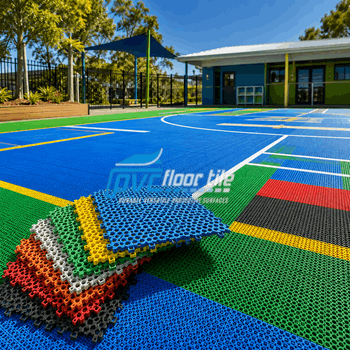
100 Piece Court Tiles – 1m² Multi-Sport Tile Pack
Colourful modular court tiles designed for sports courts, recreation areas and outdoor activity surfaces requiring drainage.
R785,00
R575,00

Explore modular airflow tiles designed for drainage, ventilation, quick installation and dependable performance in sports courts, wet areas, entrances and outdoor spaces across South Africa.
Colourful modular court tiles designed for sports courts, recreation areas and outdoor activity surfaces requiring drainage.

Modular ramp edging designed to create a neat and safer transition around compatible raised airflow and sports tile systems.

Raised open-grid tile designed for airflow, water drainage and modular floor coverage in wet, outdoor and high-use spaces.
Open-grid surfaces allow water to move through quickly instead of collecting on top.
Raised tile construction supports ventilation and helps floors dry more efficiently.
Tiles connect quickly for flexible layouts, easy replacement and straightforward installation.
Practical for sports courts, patios, pool surrounds, wash areas and demanding outdoor spaces.
PVC Floor Tile supplies Airflow Tile Systems for wet areas, wash bays, detailing bays, balconies, patios, pool surrounds, changing areas, utility spaces and other locations where drainage and ventilation are important. These raised interlocking tiles use an open-grid surface that allows water and small debris to pass below the walking surface instead of collecting directly on top.
Airflow Tile Systems are available for customers in South Africa and can be used for suitable residential, commercial and working environments. Customers can also browse our raised ventilation tile range for additional drainage and airflow flooring options.
Important: Airflow tiles are manufactured from UV-stable polypropylene (PP). They are drainage and ventilation tiles rather than solid PVC floor tiles, so they should be selected where water movement, airflow and an open-grid surface are the main requirements.
Airflow Tile Systems are designed for environments where drainage, ventilation, grip and practical maintenance are important. Their raised modular construction creates an open walking surface that allows water, dust, sand and small debris to move below the tile instead of remaining directly underfoot.
This makes them particularly useful for wash bays, wet entrances, workshops, detailing areas, balconies, patios, pool surrounds, changing facilities and utility areas where moisture or dirt regularly builds up.
Unlike a solid floor covering, the raised grid design creates space between the existing floor and the walking surface. This helps water move through the tile, supports airflow beneath the floor system and makes deeper cleaning underneath possible when required.
PVC Floor Tile supplies raised Airflow Tile Systems for customers looking for modular drainage flooring in South Africa. The range is intended for spaces where managing surface water, dirt and ventilation is more important than creating a completely closed floor surface.
When selecting a wet-area floor, consider where the water will drain, whether the underlying surface has an appropriate fall or drainage point, the amount of foot or vehicle traffic, exposure to sunlight and the cleaning requirements of the space.
Customers who are unsure whether an Airflow Tile System is appropriate for their application can contact PVC Floor Tile with details about the area, measurements and intended use before ordering.
Wet or dirty floors can become difficult to use when water, mud, sand or debris remains on the walking surface. Airflow tiles help manage this problem by raising the walking surface above the existing floor.
The open-grid design allows liquids and loose debris to move through the surface. In suitable installations, this helps reduce surface pooling and makes the area easier to rinse, sweep and maintain.
Because the flooring is modular, individual tiles can also be lifted, repositioned or replaced when necessary. This is useful in environments where access underneath the floor is required for cleaning or maintenance.
Drainage floor tiles use an open-grid structure rather than a completely closed surface. Water moves through the openings and onto the underlying floor, where the existing drainage system or floor gradient must then carry it away.
This means the tiles help manage water on the walking surface, but they do not replace the drainage design of the underlying floor. The base surface should still be suitable for water exposure and should allow water to move toward an appropriate drainage point.
The raised structure also allows air to circulate underneath the tiles, supporting drying after washing or regular exposure to moisture.
The open-grid surface is the defining feature of Airflow Tile Systems. Instead of holding water, sand and small debris on top, the openings allow these materials to move below the walking surface.
The raised design also creates a gap between the tile and the underlying floor. This supports ventilation underneath the installation and allows sections to be lifted when deeper cleaning is required.
Airflow tiles are therefore especially useful in areas where conventional closed flooring may remain wet or collect surface debris too quickly.
Airflow Tile Systems use an interlocking modular connection that allows the floor to be assembled without complicated installation work in many applications.
Before installation, check that the existing surface is stable, reasonably level and suitable for the intended wet-area application. Remove loose debris, sharp objects and other material that could affect the tile layout.
Because the flooring is modular, the coverage area can be adjusted to fit specific walkways, work zones and irregular spaces. Individual damaged tiles can also be replaced without removing the full installation.
Airflow Tile Systems can be considered for a range of areas where water, dirt, ventilation or regular cleaning needs to be managed.
Wash bays and vehicle detailing areas regularly experience water, dirt and cleaning products. Airflow tiles provide a raised walking surface while allowing water and small debris to pass through the grid.
Workshops often collect dust and small loose debris. The open-grid structure can help reduce the amount of this material remaining directly on the walking surface while providing a removable modular floor layer.
Balconies and patios may be exposed to rain, cleaning water, dust and regular foot traffic. Raised drainage tiles allow water to move through the surface while creating a modular finish above the underlying floor.
Poolside areas regularly experience water. An open-grid floor can help reduce water remaining on top of the walking surface, provided the underlying area has suitable drainage.
Changing areas and wet access zones can benefit from a raised surface that supports water movement and makes routine cleaning easier.
Laundry areas, cleaning zones, service rooms, storage spaces and other utility environments may benefit from modular flooring that can be rinsed, lifted and maintained when required.
Covered outdoor spaces that experience moisture, dirt or regular movement can use Airflow Tile Systems to create a cleaner raised walking surface.
The right flooring depends on what the space needs to achieve. Airflow Tile Systems are primarily designed for drainage, ventilation and easier maintenance in wet or dirty environments. They serve a different purpose from solid PVC flooring and impact-focused rubber flooring.
| Flooring Option | Best For | Main Benefit | Surface Design | Recommended Use |
|---|---|---|---|---|
| Airflow Tile Systems | Wet areas, wash bays, patios, pool surrounds and utility zones | Supports drainage, airflow and easier surface maintenance | Raised open-grid tile | Areas where water, sand, dust or debris needs to move below the walking surface |
| Raised Ventilation Tiles | Moisture-prone areas, changing rooms and covered outdoor spaces | Supports ventilation underneath the walking surface | Vented modular surface | Areas requiring drainage, ventilation and easier cleaning |
| Rubber Mats | Gyms, equipment areas and impact zones | Floor protection, impact support and comfort | Solid rubber surface | Better where impact protection is more important than drainage |
| Garage Flooring | Garages, workshops and vehicle areas | Creates a durable modular floor finish | Solid or application-specific modular flooring | Choose according to vehicle use, moisture and drainage requirements |
| Industrial Flooring | Factories, warehouses and production areas | Designed for demanding traffic and work environments | Application-dependent floor system | Useful where load and traffic requirements are more important than drainage |
Airflow Tile Systems are the more appropriate option when drainage, ventilation and easier cleaning are the main requirements. Where impact protection is more important, rubber flooring may be more suitable. Where a dry, closed surface is preferred, a solid flooring system may be a better fit.
| Colour | Multiple Colours Available |
| Size | 395 mm × 395 mm |
| Thickness | 18.1 mm |
| Material | UV-Stable Polypropylene (PP) |
| Surface Type | Raised open-grid surface |
| Installation | DIY interlocking installation |
| Coverage | Approximately 6.4 tiles per m² |
| Recommended Quantity | 7 tiles per m² |
| Connection | Interlocking modular system |
| Application | Indoor and outdoor use |
| UV Resistant | Yes |
| Drainage | Open-grid design for improved drainage and airflow |
| Maintenance | Sweep, vacuum, rinse, hose down or damp mop depending on the application |
| Best For | Covered work areas, vehicle bays, detailing bays, balconies, patios, pool surrounds and utility spaces |
Airflow Tile Systems provide several practical advantages where moisture, dirt or frequent cleaning needs to be managed.
Airflow Tile Systems are designed to work around water, but they should not be confused with a waterproof membrane or a completely sealed waterproof floor. The open-grid design intentionally allows water to pass through the tile onto the underlying surface.
For this reason, the underlying floor should already be suitable for moisture exposure and should have appropriate drainage where water is regularly present.
The main benefit of Airflow tiles is therefore surface drainage and ventilation, rather than creating a waterproof barrier.
Wet and dirty environments need flooring that is practical to maintain. Airflow Tile Systems separate the walking surface from some of the water, dirt and debris that moves through the grid.
In a wash bay, for example, water can pass through the tile rather than remaining across the full walking surface. In a workshop, small loose debris can move through the grid. On suitable patios or balconies, rainwater can pass through to the underlying drainage surface.
The system does not remove the need for regular cleaning. Instead, it makes the walking surface easier to manage and allows sections to be lifted for deeper maintenance.
Routine maintenance depends on the environment. Dry areas can usually be swept or vacuumed, while wet-use areas can be rinsed or washed as required.
Where debris builds up underneath the tiles, individual sections can be lifted to clean the base floor before being reinstalled.
Avoid unsuitable harsh chemicals that could affect the tile material. Mild cleaning products and water are generally more appropriate for routine maintenance.
Yes. Airflow Tile Systems can be installed over suitable concrete floors that are stable and reasonably level.
For wet applications, the concrete floor must still be capable of handling water and directing it toward an appropriate drain or outlet. Installing open-grid tiles does not correct an underlying drainage problem.
Homeowners can use Airflow Tile Systems in balconies, patios, home wash areas, pool surrounds, covered outdoor spaces, utility zones and suitable storage areas.
The modular format allows selected areas to be upgraded without extensive permanent floor work and provides access to the underlying surface when cleaning is required.
Businesses may use raised drainage tiles in wash bays, detailing areas, service zones, wet access areas, workshops and other environments where water and regular cleaning are part of everyday operations.
Because individual tiles can be replaced, businesses can maintain localised areas without necessarily removing the complete floor installation.
Inspect the underlying floor before installation. The surface should be stable, reasonably level and free from loose debris, large stones, sharp objects or other material that could interfere with the tiles.
Plan the floor layout before connecting the tiles. Where possible, begin from a straight reference edge and check alignment as installation progresses.
Tiles may need to be trimmed around walls, posts or fixed objects. Measure carefully before making cuts.
In wet areas, also check the drainage path before installation so that water passing through the tiles can continue to move away from the area.
Sweep, vacuum or rinse the tiles regularly according to the environment.
In wet applications, periodically check underneath the system to make sure dirt and debris have not blocked drainage routes.
Damaged sections should be replaced when necessary to keep the floor consistent and functional.
Browse our raised ventilation tile range for additional modular flooring options designed around drainage, airflow, grip and practical wet-area maintenance.
PVC Floor Tile supplies Airflow Tile Systems and raised ventilation tiles for suitable wet areas in South Africa. These open-grid polypropylene tiles are designed to let water move through the walking surface while supporting airflow and easier maintenance.
PVC Floor Tile supplies modular Airflow Tile Systems for wet-use and drainage-focused applications, including wash bays, detailing areas, balconies, patios, pool surrounds, changing areas and utility spaces.
They are used where drainage, ventilation and easy cleaning are important. Common applications include wash bays, patios, balconies, pool surrounds, workshops and utility areas.
No. The Airflow Tile System described on this page is manufactured from UV-stable polypropylene (PP). It is a raised drainage tile and should not be confused with solid interlocking PVC flooring.
Yes. Their open-grid design allows water to move through the surface. The underlying floor must still provide an appropriate route for the water to drain away.
They are suitable for wet applications, but they do not create a waterproof barrier. Water passes through the grid onto the underlying floor.
Yes. The tiles are UV-stable and can be used in suitable outdoor and covered outdoor applications, subject to the conditions of the installation area.
Yes. Their modular interlocking construction allows straightforward DIY installation in many applications when the underlying floor is suitable.
Yes. Individual damaged tiles can normally be removed and replaced without replacing the complete flooring system.
Yes. Sections can be lifted when deeper cleaning of the underlying floor is required.
Yes. They can be installed over suitable concrete that is stable and reasonably level. For wet areas, the concrete must also have suitable drainage.
Airflow Tile Systems provide a practical raised flooring solution for areas where water, dirt and regular cleaning need to be managed. Their open-grid polypropylene construction allows moisture and small debris to move below the walking surface while supporting ventilation underneath the installation.
They are particularly suited to wash bays, detailing bays, workshops, balconies, patios, pool surrounds, changing areas, utility spaces and other suitable wet-use environments.
If drainage is your main flooring requirement, Airflow Tile Systems provide a more appropriate solution than a closed solid tile because they are specifically designed to allow water to pass through the surface.
