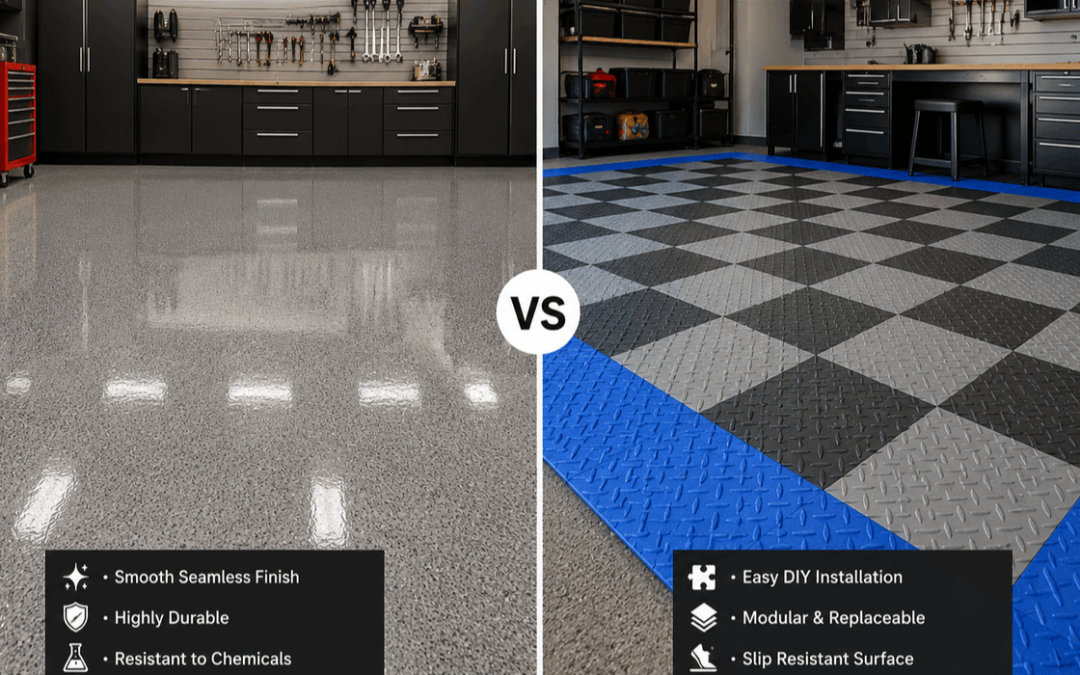
PVC flooring vs epoxy flooring is a common comparison for garages, workshops, warehouses and practical commercial spaces. Both options can improve the appearance of a floor, but they work in very different ways once the area is used every day.
PVC flooring is usually chosen when the customer wants a modular surface that can be installed over an existing floor. Epoxy flooring is a liquid coating system applied directly to concrete, usually requiring careful preparation before installation.
This guide compares PVC flooring and epoxy flooring for durability, installation, maintenance, repair, appearance, cost and long-term use. Customers who want broader product information can view our PVC floor tile solutions.
What Is PVC Flooring?
PVC flooring is a practical floor covering made from polyvinyl chloride material. In many garages, workshops and commercial spaces, PVC tiles are used as modular floor covering products that can be placed over an existing surface.
Unlike a coating, PVC flooring creates a separate surface layer above the concrete. This can help improve the appearance of the floor while also supporting daily movement, cleaning and practical use.
Customers who want to understand the material in more detail can read our PVC tile material guide.
- Useful for garages, workshops and workspaces.
- Creates a modular surface over existing concrete.
- Can be easier to repair in sections.
- Works well where practical use matters more than a painted look.
What Is Epoxy Flooring?
Epoxy flooring is a resin-based coating system applied directly onto a prepared concrete floor. When installed correctly, it can create a smooth, sealed and professional-looking finish.
The performance of epoxy depends strongly on surface preparation. The concrete usually needs to be clean, dry, stable and properly prepared before the coating is applied. If the floor has moisture, oil, dust or poor preparation, epoxy may fail over time.
For general material background, you can view this epoxy resin background information.
PVC Flooring vs Epoxy Flooring: Quick Comparison
The better option depends on the condition of the existing floor, the type of traffic, how quickly the area must be used and whether future repair flexibility is important.
| Factor | PVC Flooring | Epoxy Flooring |
|---|---|---|
| Installation | Modular tiles are placed over the existing floor. | Liquid coating applied to prepared concrete. |
| Floor preparation | Usually less dependent on perfect concrete condition. | Requires strong preparation for good bonding. |
| Repair | Selected sections may be replaced depending on the system. | Repairs may require patching and recoating. |
| Downtime | Can often be quicker to install and use. | May require curing time before use. |
| Best use | Practical garages, workshops and modular work areas. | Smooth coated floors where preparation is excellent. |
Installation Differences
Installation is one of the biggest differences between PVC flooring and epoxy flooring. PVC flooring is usually installed as a modular product. This means the floor covering is laid over the surface, depending on the product type and the condition of the floor.
Epoxy is different because it is applied as a coating. The concrete must be cleaned and prepared carefully before the epoxy system is installed. This may include grinding, repairing, degreasing or moisture testing depending on the floor condition.
For workshops where installation flexibility matters, PVC can be more convenient. Epoxy can create a clean finish, but it normally needs more preparation and curing time.
Durability and Daily Use
Both PVC flooring and epoxy flooring can be durable when used in the right environment. However, they handle wear differently.
PVC flooring provides a physical layer over the concrete. This makes it useful in garages and work areas where the floor experiences foot traffic, tools, storage items, light equipment and everyday movement.
Epoxy can also be durable, but if the coating is scratched, chipped or affected by poor bonding, repairs may be more complicated. Its long-term performance depends heavily on the quality of installation and the condition of the concrete.
Maintenance and Cleaning
Maintenance is important for any working floor. Garages, workshops and commercial spaces can collect dust, dirt, tyre marks and general daily wear.
PVC flooring is usually practical to sweep and clean. Because it is modular, some systems also make it easier to deal with localised damage or wear in specific areas.
Epoxy floors can be easy to clean when the coating is in good condition. However, once the coating is damaged or worn, the surface may become more difficult to keep looking consistent.
Repair and Replacement
Repair flexibility is one of the reasons some customers choose PVC flooring. If one section is damaged, selected tiles may be replaced depending on the product and installation method.
Epoxy is a continuous coating, so repairs are not always as simple. A damaged area may need to be sanded, patched and recoated. Colour matching can also be difficult if the original floor has aged or changed appearance.
For areas where tools, equipment or stock movement may damage sections of the floor, modular repair flexibility can be useful.
Appearance and Finish
Epoxy flooring can create a smooth and polished appearance when applied correctly. It is often chosen where a seamless, glossy or coated floor finish is preferred.
PVC flooring gives a different look. It creates a modular tile finish that can make a garage, workshop or commercial space look more organised and practical.
The better appearance depends on the style of the space. Epoxy may suit areas where a seamless coating is the main goal. PVC may suit areas where the customer wants a strong, practical and replaceable surface.
Moisture and Floor Condition
Moisture is a major factor when comparing PVC flooring vs epoxy flooring. Epoxy must bond to the concrete surface. If the concrete has moisture issues, oil contamination, dust or weak areas, the coating may not perform as expected.
PVC flooring is not a repair for serious moisture or structural problems, but it is usually less dependent on chemical bonding to the concrete. The floor should still be checked before installation.
If the existing surface has major cracks, damp issues or loose concrete, those problems should be addressed before any floor finish is installed.
Cost and Long-Term Value
Epoxy may look attractive from a cost perspective depending on the product and installation. However, the final cost can increase when surface preparation, professional application and downtime are included.
PVC flooring may have a higher product cost in some cases, but it can offer better value where installation speed, repair flexibility and practical daily use are important.
The lowest starting price is not always the best long-term decision. The right choice should consider use, maintenance, repair and how long the floor needs to perform.
Best Areas for PVC Flooring
PVC flooring is usually a strong choice for areas where practical daily use matters. It is especially useful where the customer wants a modular surface that can support movement, cleaning and general floor protection.
- Garages used for vehicles and storage.
- Workshops and utility spaces.
- Commercial work areas.
- Light industrial spaces.
- Showrooms and service areas.
- Areas where future tile replacement may be useful.
Best Areas for Epoxy Flooring
Epoxy flooring can work well when the concrete surface is in good condition and the customer wants a smooth coated finish. It may suit areas where appearance, sealing and a continuous surface are the main priorities.
- Smooth concrete floors with strong preparation.
- Spaces where a coated finish is preferred.
- Areas with controlled conditions during installation.
- Floors where curing time is not a problem.
- Projects where professional surface preparation is included.
Which Is Better for Workshops?
Workshops often need flooring that can handle tools, movement, standing areas, storage and cleaning. In these spaces, practicality matters more than appearance alone.
PVC flooring is often a better choice where the workshop needs a modular surface that can be installed with less downtime and repaired in sections if needed.
Epoxy may still work well where the floor is properly prepared and a coated finish is preferred. For a more detailed workshop comparison, read our guide on PVC tiles vs epoxy in workshops.
Final Verdict: PVC Flooring vs Epoxy Flooring
When comparing PVC flooring vs epoxy flooring, the best option depends on the condition of the existing floor, the type of space and how the area will be used.
PVC flooring is usually better for customers who want modular installation, practical repair options and a surface suited to garages, workshops and work areas. It is a strong choice where daily use, maintenance and long-term flexibility matter.
Epoxy flooring can be suitable where the floor is properly prepared, the customer wants a smooth coated finish and curing time is not a problem. It can look clean and professional, but it depends heavily on preparation and installation quality.
Frequently Asked Questions
Is PVC flooring better than epoxy flooring?
PVC flooring is often better for modular installation, repair flexibility and practical work areas. Epoxy may be better where a smooth coated finish is preferred.
Is epoxy flooring good for workshops?
Epoxy can work in workshops if the concrete is well prepared. PVC flooring may be more practical where repair flexibility and lower downtime matter.
Which is easier to repair?
PVC flooring is usually easier to repair in sections, depending on the product. Epoxy repairs may require patching and recoating.
Which option is better for garages?
PVC flooring is often more practical for active garages because it creates a modular surface over the concrete.
Does epoxy need floor preparation?
Yes. Epoxy performance depends heavily on proper concrete preparation, cleaning and bonding.
Need Help Comparing PVC and Epoxy Flooring?
Contact PVC Floor Tile for practical advice on choosing a suitable floor covering for your garage, workshop or commercial space.
Contact Us