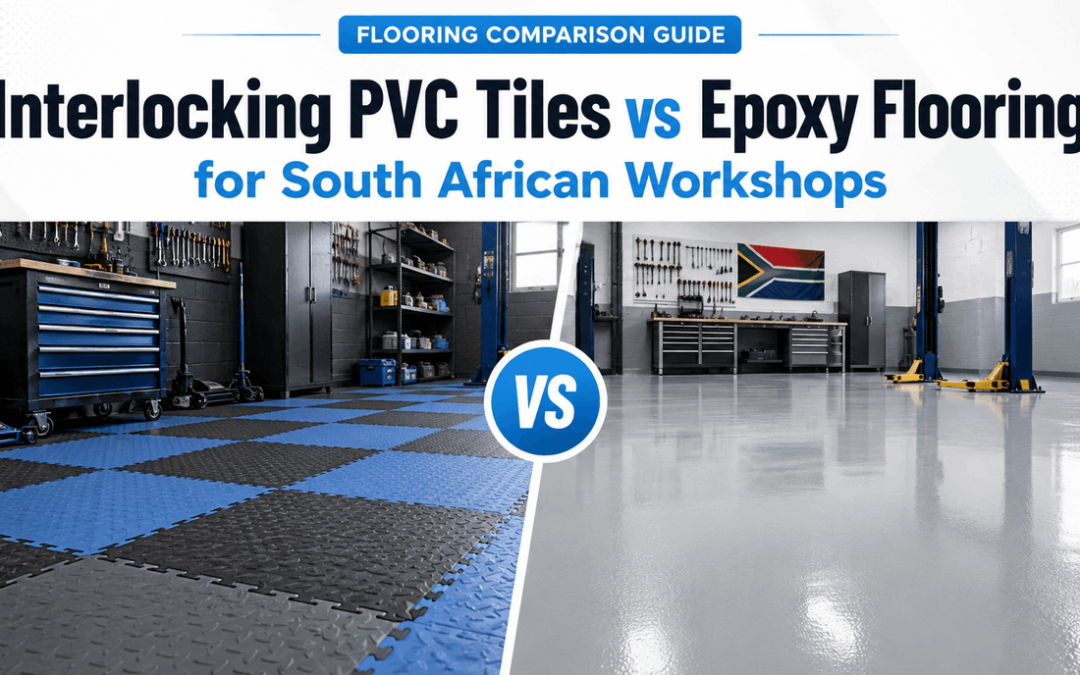
Choosing between interlocking PVC tiles and epoxy flooring is an important decision for South African workshop owners. Both options can improve the look, safety and usability of a concrete floor, but they perform differently when it comes to installation time, repairs, cost, chemical spills, vehicle traffic and long-term maintenance.
For South African workshop owners comparing long-term flooring options, heavy-duty workshop flooring offers a practical alternative to epoxy flooring because it is quicker to install, easier to repair and suitable for busy garage, workshop and light-industrial spaces.
Quick Answer: Which Is Better for Workshops?
Interlocking PVC tiles are usually better for active workshops that need fast installation, easy repairs and less downtime. Epoxy flooring can work well where a smooth, permanent coating is required, but it needs proper concrete preparation, curing time and professional application to perform properly.
What This Guide Covers
Interlocking PVC Tiles vs Epoxy Flooring: Quick Comparison
Before choosing a workshop floor, compare the practical differences. A floor that looks affordable at first can become expensive if it causes long downtime, difficult repairs or repeated maintenance problems.
| Feature | Interlocking PVC Tiles | Epoxy Flooring |
|---|---|---|
| Installation | Quick modular installation over suitable concrete | Requires surface grinding, preparation and curing |
| Workshop Downtime | Lower downtime in most cases | Higher downtime while coating cures |
| DIY Friendly | More suitable for DIY installation | Usually needs professional application |
| Repairs | Individual tiles can be replaced | Damaged areas may need patching or recoating |
| Concrete Movement | More forgiving over minor cracks or movement | Can crack or peel if the slab moves |
| Vehicle Use | Good for garages, workshops and rolling loads when the correct tile is selected | Good if professionally installed on well-prepared concrete |
| Appearance | Industrial modular tile finish | Smooth seamless coated finish |
| Best For | Workshops, garages, factories and practical commercial floors | Showrooms, decorative garages and smooth coated floors |
What Are Interlocking PVC Tiles?
Interlocking PVC tiles are modular floor tiles designed to connect together without the need for a full adhesive installation in many standard applications. Instead of permanently coating the concrete, the tiles create a tough surface over the existing floor.
Unlike permanent coatings, interlocking PVC tiles are modular flooring products that can be installed over suitable concrete surfaces and replaced in sections when needed. This makes them a practical choice for South African workshops, garages, factories, warehouses and light-industrial areas.
Fast Installation
Tiles can be installed in sections, helping workshops reduce disruption and avoid long closure periods.
Easy Repairs
If one section becomes damaged, individual tiles can often be replaced instead of redoing the entire floor.
Practical Strength
Heavy-duty PVC tiles are suitable for many workshops, garages and commercial environments when the correct product is selected.
What Is Epoxy Flooring?
Epoxy flooring is a resin-based coating applied directly onto concrete. Once cured, it creates a hard, smooth and sealed surface. It is often used in showrooms, garages, factories and workshops where a clean coated finish is required.
The main challenge with epoxy is that the final result depends heavily on the condition of the concrete and the quality of preparation. If the floor has moisture, dust, oil contamination, cracks or poor preparation, the epoxy may peel, bubble, chip or crack over time.
Installation Time: Which Flooring Is Faster?
Interlocking PVC Tiles
Interlocking PVC tiles are normally quicker to install because they do not require the same surface preparation and curing time as epoxy. A clean, stable and reasonably level concrete floor is usually enough for many standard tile installations.
This is a major advantage for workshops that cannot stop working for several days. Machines, vehicles and stock can often be moved section by section while the floor is installed.
Epoxy Flooring
Epoxy takes longer because the concrete normally needs grinding, cleaning, repairing, priming and curing. During this time, the area may need to remain unused. For a busy workshop, downtime can affect production, staff movement and customer service.
Installation Winner
Interlocking PVC tiles are usually the better option where fast turnaround and reduced downtime are important.
Cost Per Square Metre and Real Workshop Downtime
When comparing interlocking PVC tiles vs epoxy flooring, do not only look at the product price. The real cost should include preparation, labour, downtime, repairs and future maintenance.
Epoxy Cost Considerations
Epoxy may look cost-effective at first, but the final price can increase if the floor needs grinding, crack repairs, moisture treatment or specialist application. A poor installation can also become expensive later if the coating fails.
PVC Tile Cost Considerations
Interlocking PVC tiles give buyers more control because the floor can be installed in sections, repaired per tile and upgraded without permanently bonding a coating to the concrete. This can be useful for workshops that want practical flooring without major downtime.
For accurate pricing, the best step is to measure your workshop and request advice based on your floor condition, tile thickness, quantity and delivery area.
Crack Resistance and Concrete Movement
Many South African workshops have older concrete floors with expansion joints, hairline cracks, small slopes or patched areas. These floor conditions matter because epoxy and PVC tiles respond differently to movement.
How PVC Tiles Handle Minor Concrete Issues
Interlocking PVC tiles are more forgiving because they are not permanently bonded to the slab. If the concrete has small cracks or minor movement, the tiles can still perform well, provided the floor is stable and not badly damaged.
How Epoxy Handles Concrete Movement
Epoxy is bonded directly to the concrete. If the concrete moves, cracks or has moisture problems, the coating may show damage on the surface. That is why proper surface preparation is very important before epoxy is installed.
Important Note
Interlocking tiles should not be used to hide serious concrete problems. Large holes, loose concrete, deep cracks and major uneven levels should be repaired before any flooring system is installed.
Oil, Petrol, Brake Fluid and Workshop Spills
Workshops often deal with oil, grease, petrol, brake fluid, water and cleaning chemicals. Both flooring options require proper cleaning habits to protect the surface and reduce slip risks.
PVC Tiles and Spills
PVC flooring is practical for many workshop environments because spills can be cleaned from the surface. However, harsh chemicals should not be left sitting for long periods. Quick cleaning helps reduce staining and surface damage.
Epoxy and Spills
Epoxy can offer good chemical resistance when the correct coating system is used, but lower-quality coatings or poorly prepared floors may stain, soften or become slippery if spills are not managed properly.
In all workshops, spills should be cleaned quickly and staff should follow workplace safety procedures.
Repairs and Maintenance: Which Is Easier Long-Term?
Maintaining Interlocking PVC Tiles
PVC tiles are easy to sweep, mop and spot-clean. If one section becomes worn or damaged, the affected tile can usually be replaced. This makes PVC tiles ideal for workshops where tools, vehicles, machines and heavy foot traffic can damage specific areas over time.
Maintaining Epoxy Flooring
Epoxy is easy to clean when it is still in good condition. However, once the coating becomes scratched, chipped or worn, repairs can be more complicated. Patching may be visible, and some areas may need sanding or recoating.
Maintenance Winner
Interlocking PVC tiles are usually easier to repair because individual sections can be replaced.
Workshop floors should be kept clean and safe because oil, petrol, brake fluid and water spills can increase slip risks. For general workplace safety responsibilities in South Africa, businesses can refer to the Occupational Health and Safety Act information on the South African Government website .
Which Flooring Is Better for South African Workshops?
For many South African workshops, interlocking PVC tiles are the more practical choice because they offer faster installation, easier repairs, lower downtime and better flexibility over imperfect concrete floors.
Epoxy flooring can still be a good option where the owner wants a seamless coated finish and has enough time for proper preparation, professional application and curing.
Choose Interlocking PVC Tiles If:
- You want faster installation
- You want less workshop downtime
- You prefer modular repairs
- You need a DIY-friendly flooring option
- Your floor has minor cracks or old concrete
- You want a practical industrial finish
- You want a floor that can be replaced in sections
Choose Epoxy Flooring If:
- You want a smooth seamless finish
- Your concrete is in excellent condition
- You can allow curing time
- You are using a professional installer
- You want a decorative coated surface
- Your floor has limited moisture or movement issues
- You accept more complex future repairs
Final Verdict: Interlocking PVC Tiles vs Epoxy Flooring
Both flooring systems can work, but they are not equal in every workshop environment. Epoxy is best for buyers who want a permanent, smooth and seamless coated finish. Interlocking PVC tiles are better for buyers who want practical strength, quicker installation, easier repairs and less disruption to daily operations.
For many South African workshops, garages and light-industrial spaces, interlocking PVC tiles are the better long-term flooring choice because they combine durability with flexibility and simple maintenance.
Frequently Asked Questions
Are interlocking PVC tiles better than epoxy flooring?
Interlocking PVC tiles are often better for workshops that need quick installation, easy repairs and lower downtime. Epoxy flooring can be better where a smooth seamless coated finish is required and the concrete is properly prepared.
Can PVC tiles be installed over old concrete?
Yes, PVC tiles can often be installed over old concrete if the surface is clean, stable and reasonably level. Large holes, loose concrete and major uneven areas should be repaired before installation.
Is epoxy flooring good for workshops?
Yes, epoxy flooring can be good for workshops when it is professionally installed over properly prepared concrete. However, it needs curing time and can fail if the slab has moisture, cracks or poor preparation.
Which flooring is easier to repair?
Interlocking PVC tiles are usually easier to repair because damaged tiles can be replaced individually. Epoxy repairs may require patching, sanding or recoating.
Do interlocking PVC tiles need glue?
Many interlocking PVC tiles do not need glue for standard installations. However, areas with heavy turning loads, ramps or extreme traffic may need additional installation advice.
Which flooring is better for DIY installation?
Interlocking PVC tiles are generally more DIY-friendly. Epoxy flooring is more technical and normally requires proper surface preparation, mixing, application and curing.
Can oil or petrol damage PVC flooring?
Oil, petrol and workshop chemicals should be cleaned quickly. PVC flooring is practical for workshop use, but long exposure to harsh chemicals can cause staining or surface damage.
Need Help Choosing the Right Workshop Floor?
PVC Floor Tile can help you compare interlocking PVC tiles, garage flooring, workshop flooring and rubber flooring options before you buy. Speak to our team for advice, request a quote or visit our Randburg showroom to view flooring samples.
