
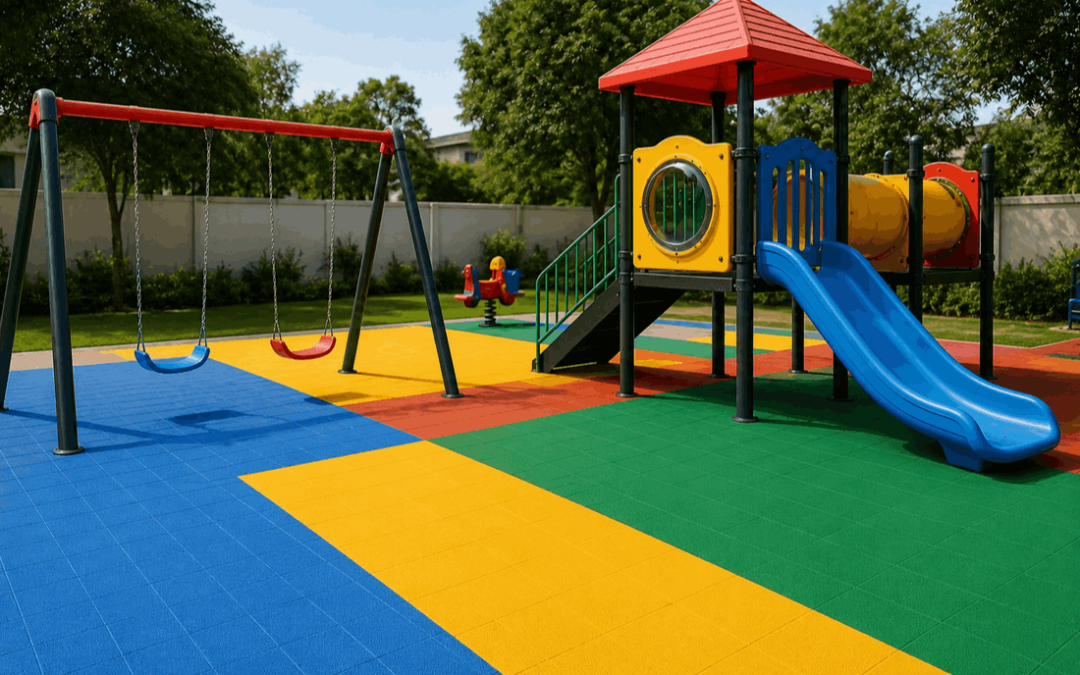
Choosing between playground tiles vs rubber mats is not simply a matter of deciding which surface looks softer or costs less. The better option depends on whether the play area is indoors or outdoors, the supporting base, drainage, equipment type, expected traffic and the technical specification of the product. Playground flooring must be assessed as one part of the complete play environment, together with equipment placement, supervision, access and maintenance. Explore our outdoor playground tiles for schools, crèches, residential play areas and recreational facilities.
Playgrounds are used in schools, childcare centres, residential complexes, public parks, restaurants, community centres and private homes. Some spaces contain fixed climbing equipment and slides, while others are open activity areas used for movement, games, sitting and general recreation.
Because these applications differ, no single flooring option can automatically be declared the best for every play area. Open-grid playground tiles may suit certain outdoor areas that need surface drainage and modular replacement. Suitable rubber mats may work well in selected indoor, covered or specifically designed applications.
This guide compares the two options according to construction, drainage, installation, comfort, cleaning, movement control and long-term maintenance.
Which option is better?
Playground tiles may be better for selected outdoor areas where drainage, colour zoning and sectional replacement are important. Rubber mats may suit selected indoor, covered or purpose-specified areas where a closed or cushioned surface is preferred. The final decision must be based on the exact product, playground equipment, supporting base and installation requirements.
What Are Playground Tiles?
Playground tiles are modular flooring sections designed to join together across a prepared area. Depending on the product, they may use an interlocking connection that helps form one continuous surface.
Some outdoor playground tiles use an open-grid design. Rainwater can pass through openings in the upper surface before reaching the supporting concrete. The water must then follow the slope of the base towards an open edge, channel or drainage outlet.
Other playground tiles have a more closed surface. These may have different drainage and cleaning characteristics. The construction should therefore be checked rather than assuming every playground tile functions in the same way.
Typical characteristics
- Individual modular sections
- Interlocking connection systems
- Open-grid or closed-surface designs
- Several possible colour combinations
- Replaceable individual sections
- Defined borders and activity zones
- Specific supporting-base requirements
Typical characteristics
- Loose-laid or interconnected sections
- Different thicknesses and densities
- Textured or smoother surfaces
- Individual mats or rubber tiles
- Indoor or outdoor specifications
- Different edge-control requirements
- Application-specific performance
What Are Rubber Mats for Play Areas?
Rubber mats are individual rubber flooring sections that may be loose-laid, positioned beside each other or connected through an interlocking system. Products differ considerably in material composition, thickness, density, surface texture and intended use.
A rubber entrance mat, gym mat and tested playground surfacing product are not automatically interchangeable. A mat that feels soft underfoot should not be assumed to provide a specific level of impact attenuation beneath elevated playground equipment.
For this reason, buyers should confirm the exact application, installation method and available product information before using rubber mats in a children’s play area.
Important product distinction: Rubber mats, rubber tiles, PVC playground tiles and EVA foam mats are different product groups. Do not use these terms interchangeably in product descriptions or quotations.
Playground Tiles vs Rubber Mats: Quick Comparison
| Comparison factor | Playground tiles | Rubber mats |
|---|---|---|
| Surface format | Connected modular sections covering the full area. | Individual mats or interconnected rubber sections. |
| Outdoor drainage | Open-grid options can allow water through the upper surface. | Depends on mat design, drainage channels and installation. |
| Replacement | Selected tiles may be replaceable individually. | A damaged mat or rubber section may need replacement. |
| Colour planning | Multiple colours can define play and access zones. | Colour choice depends on the available rubber product. |
| Movement control | Interlocking connections help create a joined surface. | Loose mats require suitable edge and movement control. |
| Cleaning | Debris may collect in openings or beneath tiles. | Closed mat surfaces may be easier to wipe, depending on texture. |
| Impact performance | Must be confirmed for the exact tile and installation. | Must be confirmed for the exact mat and installation. |
| Best application | Often considered for planned modular outdoor areas. | May suit selected indoor, covered or specified applications. |
1. Indoor Versus Outdoor Play Areas
The location of the playground is one of the first factors to consider. Outdoor surfaces may be exposed to rain, sunlight, dust, leaves, garden soil and changes in temperature. Indoor surfaces are protected from regular rain but may experience spills, food, dust and repeated cleaning.
An outdoor product should be specifically intended for outdoor exposure. An indoor product should not be placed outside simply because it is interlocking or feels comfortable.
Outdoor playground
Prioritise drainage, base slope, weather exposure, perimeter planning and outdoor product suitability.
Covered play area
Check wind-driven rain, moisture near entrances and whether the area remains partly exposed.
Indoor playroom
Prioritise cleaning, movement control, indoor suitability and the type of activity planned.
2. Drainage After Rain
Drainage is one of the strongest differences in a playground tiles vs rubber mats comparison. Open-grid playground tiles can allow rainwater through the upper surface. However, the water does not disappear. It reaches the base beneath the tiles and must still flow away.
A concrete slab with low spots may retain water underneath the modular floor. Blocked outlets, raised edging and an incorrect slope can also prevent effective drainage.
Rubber mats may include holes, channels or raised undersides, but drainage performance depends on the exact design. A large closed mat laid flat over a wet base may trap moisture or slow drying.
The Flooring Does Not Repair the Drainage
Whether the project uses playground tiles or rubber mats, the supporting base must direct water towards an appropriate outlet. A drainage-friendly surface cannot reverse an incorrect concrete slope or repair blocked stormwater infrastructure.
3. Supporting-Base Requirements
Both flooring types need appropriate support. Modular playground tiles commonly require a firm, stable and reasonably even surface. Loose soil, muddy grass and uncompacted fill can move beneath the tiles and affect alignment.
Rubber mats also need stable support. Mats placed over uneven ground may rock, curl, separate or create raised transitions.
Inspect the intended base for:
- Large or moving cracks
- Loose concrete
- Deep low areas
- Standing water
- Uncompacted ground
- Uneven previous repairs
- Sharp changes in height
- Uncontrolled roof water
- Blocked drainage outlets
- Unstable perimeter sections
Installing new flooring over a damaged base does not correct the underlying problem. Repairs should be completed before installation where necessary.
4. Surface Comfort
Rubber mats are often selected because rubber can provide a resilient feel underfoot. However, comfort varies according to thickness, density, material composition and base condition.
A modular playground tile may feel firmer than a thick rubber mat, but this does not automatically make it unsuitable. The preferred feel depends on whether the area is used for running, sitting, crawling, general games or equipment-based activity.
Comfort should also be separated from tested impact performance. A product may feel cushioned without meeting the requirements of a particular elevated equipment zone.
5. Impact Attenuation and Equipment Fall Areas
This is one of the most important parts of selecting play-area flooring. No playground tile or rubber mat should be described as fall-rated simply because it is soft, thick or made from rubber.
Where flooring is intended beneath elevated equipment, ask for relevant information for the complete installed system. Product thickness alone does not explain how the surface performs.
Do not make unsupported safety claims: Confirm the product’s intended application, available test information, required base, installation method and maintenance conditions before placing it beneath elevated playground equipment.
6. Movement and Edge Control
Interlocking playground tiles connect across the surface, which can help create a unified installation. Appropriate expansion space, borders and perimeter transitions must still be planned according to the system.
Individual rubber mats can move if they are not sufficiently heavy, connected, restrained or installed according to the manufacturer’s instructions. Curling corners and separated edges should be addressed before the area returns to normal use.
For modular tiles
- Check all tile connections
- Follow expansion guidance
- Use compatible edge pieces
- Keep drainage edges open
- Inspect movement around equipment posts
For rubber mats
- Prevent gaps between mats
- Control curling corners
- Secure exposed transitions
- Check movement during use
- Use the recommended installation method
7. Cleaning and Hygiene
Neither surface should be described as maintenance-free. Outdoor playground tiles may collect dust, leaves, sand and small debris in drainage openings or beneath the surface. Regular sweeping and occasional lifting of selected sections may be necessary, depending on the design.
Closed rubber mats may be easier to wipe or mop, but textured surfaces and joints can still collect dirt. Moisture should not be allowed to remain trapped beneath loose mats.
| Cleaning task | Playground tiles | Rubber mats |
|---|---|---|
| Loose debris | Sweep leaves, dust and sand from the surface. | Sweep or vacuum according to the mat location. |
| Mud | Clean entrances and clear drainage openings. | Remove mud promptly and check beneath loose mats. |
| Spills | Use a cleaner suitable for the selected tile. | Use a cleaner approved for the rubber material. |
| Inspection | Check connections, edges and blocked openings. | Check corners, gaps, movement and undersides. |
8. Sectional Replacement
A key benefit of modular playground tiles is the possibility of replacing a damaged section without removing the entire floor. This depends on continued access to a compatible tile model and connection system.
Rubber mats can also be replaced individually when the area consists of separate mats. However, matching the original colour, dimensions, thickness and material may become difficult later.
Keep a record of the product name, tile or mat dimensions, colour, batch information and supplier. Retaining a small quantity of spare flooring can assist with future repairs.
9. Colour and Activity-Zone Planning
Playground tiles are often available in several colours, making them suitable for defined activity zones, entrances, borders and simple learning patterns.
Rubber mats may have fewer colour options, depending on the product. This is not necessarily a disadvantage when a calm, neutral or single-colour area is preferred.
Keep the Colour Layout Practical
- Use colours to identify meaningful zones.
- Keep entrances and walking routes visible.
- Avoid overly complicated patterns.
- Plan around fixed playground equipment.
- Record the quantity required in each colour.
10. Installation Complexity
The installation time depends on the size and shape of the area, base condition, product system, number of cuts and colour design.
A simple rectangular modular floor may be easier to plan than an irregular playground containing many posts, curves and fixed structures. Rubber mats may appear simple to place, but edges, gaps and movement still require attention.
Schools, public facilities and complex equipment areas may benefit from professional measurement and installation.
11. Temporary and Permanent Play Areas
Some indoor rubber mats can be moved or stored when a multipurpose room is needed for other activities. This can suit temporary play zones, provided the mats are repositioned correctly before each use.
A complete modular playground tile installation is generally better suited to a planned area that remains in place. Although individual tiles may be removable, repeatedly dismantling a large installation may not be practical.
Temporary area
- Consider the storage space available
- Control movement between sections
- Inspect the floor after every setup
- Keep entrances and edges flat
- Use flooring intended for the activity
Permanent area
- Prepare the base before installation
- Plan drainage and perimeter transitions
- Measure around fixed equipment
- Establish a cleaning schedule
- Retain spare sections for repairs
12. Suitability for Schools and Crèches
Schools and childcare facilities often need flooring that can support frequent daily use, organised cleaning and regular inspections.
Outdoor modular playground tiles may suit courtyards and activity areas where drainage and colour zoning are important. Suitable rubber mats may be considered for selected indoor rooms, covered areas or specific equipment applications.
The person responsible for the facility should establish who inspects the flooring, how damage is reported and when an affected area must be closed for repairs.
13. Suitability for Residential Play Areas
Residential play areas may have lower traffic, but they still require a suitable base, drainage and regular maintenance. Homeowners should consider garden irrigation, roof downpipes, soil movement and access from muddy lawns.
A small modular tile installation may create a defined outdoor activity zone. Rubber mats may be useful in a covered playroom or another application for which the selected mat is intended.
The play area should remain separated from vehicle routes, unsecured pools, garden tools and other household hazards.
14. Weather and Sunlight
Outdoor flooring may be exposed to direct sunlight and changing temperatures. Ask whether the exact tile or rubber product is intended for the planned outdoor environment.
Avoid applying broad claims such as “UV proof” or “will never fade” unless they are supported by the product information. All materials may show some change over time depending on exposure, cleaning and use.
15. Maintenance and Inspections
Regular inspections can identify loose connections, raised edges, damaged sections, blocked drainage and changes in the supporting base.
Include these checks in the maintenance routine:
- Loose connections
- Curling mat corners
- Separated sections
- Raised perimeter edges
- Blocked drainage openings
- Standing water
- Cracked flooring sections
- Movement around equipment
- Mud and loose debris
- Changes in the supporting base
Damaged areas should be repaired, replaced or isolated before normal use continues. Flooring inspections should form part of a wider playground inspection that also covers equipment, gates, fencing and access routes.
How to Choose Between Playground Tiles and Rubber Mats
Define the play-area application
Identify whether the area is indoors, covered or fully outdoors and list the activities and equipment planned.
Inspect the supporting base
Check stability, levels, cracks, moisture and drainage before choosing the surface.
Confirm the product specification
Ask about material, dimensions, thickness, intended use, cleaning and available technical information.
Plan installation and maintenance
Consider edge control, movement, drainage, cleaning access, spare sections and future replacement.
Questions to Ask the Flooring Supplier
- Is the product intended for indoor or outdoor use?
- What supporting base is required?
- How does water move through or around the surface?
- What are the tile or mat dimensions?
- What thickness and material specification apply?
- How should exposed edges be finished?
- Can individual sections be replaced?
- What cleaning products are recommended?
- Is technical testing available for the planned application?
- Does the quotation include delivery and installation?
Common Play-Area Flooring Mistakes
One common mistake is assuming that every rubber product is suitable for a playground. Rubber gym flooring, entrance mats and playground surfacing may have different constructions and intended applications.
Another mistake is choosing modular tiles for an outdoor area without inspecting the base drainage. Water passing through an open-grid surface still needs a route away from the installation.
Avoid with tiles
- Installing over loose ground
- Ignoring base drainage
- Blocking the lowest perimeter edge
- Mixing incompatible tile systems
- Making unsupported safety claims
Avoid with mats
- Leaving loose gaps between mats
- Ignoring curling corners
- Trapping moisture underneath
- Using an unsuitable indoor product outside
- Assuming softness proves fall protection
External Playground-Safety Guidance
The complete playground should be considered, not only the flooring. Equipment selection, layout, surfacing, access, inspection and maintenance all influence how the area performs.
For additional general guidance, review the Public Playground Safety Handbook from the U.S. Consumer Product Safety Commission. South African projects should still follow applicable local requirements and obtain professional advice where necessary.
Final Verdict: Playground Tiles vs Rubber Mats
The answer depends on the environment and intended use. Playground tiles may be a stronger option for selected outdoor areas where a connected modular layout, drainage openings, colour zoning and sectional replacement are priorities.
Rubber mats may be suitable for selected indoor, covered or purpose-designed applications where the mat’s material, thickness, edge control and installation method match the planned use.
Neither option should be selected on appearance or softness alone. Inspect the supporting base, identify the equipment, consider drainage and confirm the exact product specification.
Choose playground tiles when:
- You need a connected modular surface
- Outdoor drainage is an important consideration
- You want several colour zones
- Individual tile replacement is valuable
- The base meets the tile requirements
Consider rubber mats when:
- The application suits the exact rubber product
- The area is indoor or suitably covered
- Edge and movement control can be managed
- The required technical information is available
- The mats can be cleaned and inspected easily
Need Help Choosing Play-Area Flooring?
PVC Floor Tile supplies modular playground flooring for schools, crèches, residential developments, community facilities and outdoor activity areas across South Africa. Send our team the area dimensions, project location, photographs of the existing base and details of the planned playground equipment. We will help you compare suitable options for the intended application.
Contact Us