
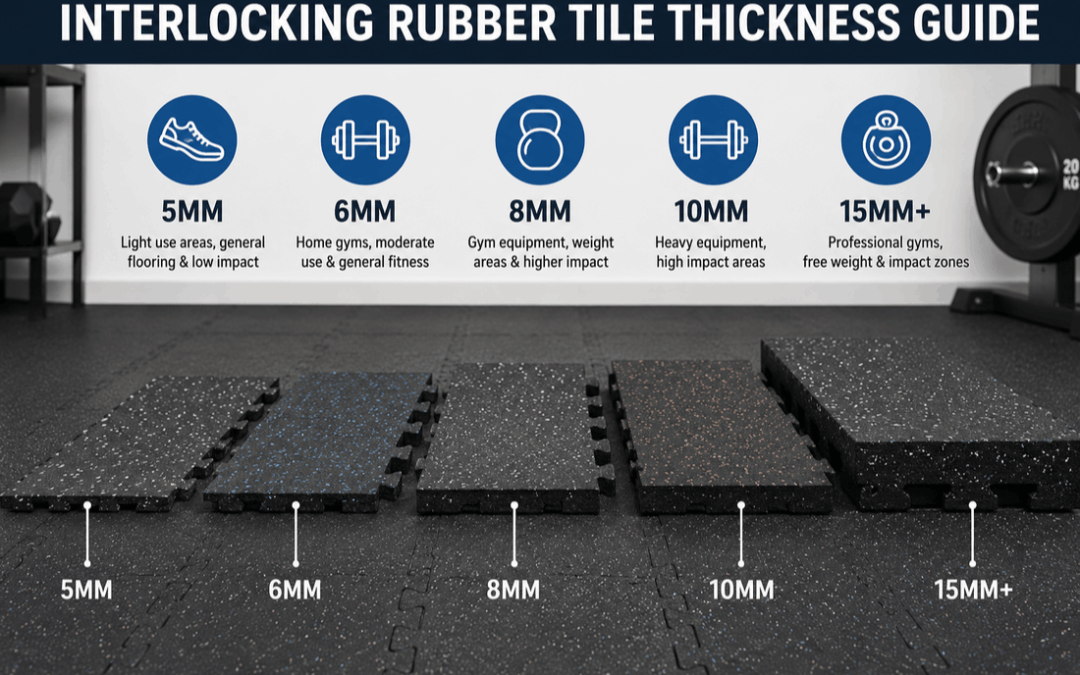
This interlocking rubber tile thickness guide explains how to compare 5mm, 6mm, 8mm and 10mm flooring without assuming that the thickest option is automatically the best. Tile depth should be considered together with rubber composition, density, equipment load, expected impact, supporting-floor condition and doorway clearance. Browse our range of interlocking rubber tiles after identifying the thickness range most suitable for your project.
Thickness affects the amount of material between the activity above and the supporting floor below. However, two tiles with the same stated thickness may perform differently when their rubber composition, density, backing, surface profile or intended application is different.
A thinner tile can be practical for general floor coverage and controlled pedestrian use. A thicker tile may be more appropriate beneath equipment or in an area exposed to greater pressure, but thickness alone does not confirm impact resistance, chemical resistance or load capacity.
The correct choice begins with the room, equipment and daily activity. It should then be checked against the technical specification of the exact tile being considered.
How to Use This Interlocking Rubber Tile Thickness Guide
Use the interlocking rubber tile thickness guide as a starting point rather than a fixed rule. First identify the heaviest equipment, expected impact, traffic and supporting floor, and then confirm that the selected product is designed for those conditions.
Why Rubber Tile Thickness Matters
Tile thickness influences floor height, edge transitions, door clearance and the amount of rubber material positioned beneath equipment and foot traffic.
A thicker tile may provide greater separation between equipment and the original floor. It can also increase the height difference where the rubber flooring joins ceramic tiles, concrete, laminate or another surface.
Thickness can affect installation as well. Thicker tiles may require more controlled cutting, stronger edging and careful planning around doors, cupboards and fixed equipment.
More material depth
Greater thickness may provide additional separation between equipment and the supporting surface.
Higher finished floor
Increasing thickness can affect doors, ramps, skirting and neighbouring floor finishes.
Different cutting needs
Thicker rubber may require more controlled knife passes and stronger finishing details.
Thickness and Density Are Not the Same
Thickness measures the depth of the tile. Density describes how much material is contained within a given volume and can influence firmness, compression and equipment stability.
A thick but very soft tile may compress more beneath narrow equipment feet than a thinner and denser tile. This is why product photographs and thickness numbers alone are not enough for final selection.
Ask for the material description, intended application and other technical information available for the exact product. The supplier should also be told whether the area will handle pedestrians, gym equipment, trolleys, machinery or repeated impact.
Important: Do not compare rubber tiles only by millimetres. Material quality, density, surface construction, interlocking design and intended use also matter.
5mm Interlocking Rubber Tiles
Five-millimetre tiles are commonly considered for general floor coverage, lighter traffic and selected home or commercial areas where severe impact is not expected.
Possible applications can include utility rooms, controlled workshop sections, home exercise spaces, storage rooms, pedestrian zones and areas beneath lighter equipment.
A 5mm tile should not automatically be placed beneath repeatedly dropped barbells, heavily loaded machines or equipment with very small pressure points. Protective pads or a thicker specialist surface may be needed.
Customers considering a common 5mm format can review the Rubber Interlocking Tiles 500 × 500 × 5mm product page and compare its specification with the intended use.
Possible 5mm applications
- General pedestrian floor coverage
- Utility and storage rooms
- Light home exercise spaces
- Selected workshop walkways
- Commercial back-room sections
- Controlled equipment areas
Confirm another option for
- Repeated heavy weight dropping
- Large industrial machinery
- Extreme point loads
- Heavy loaded trolley turning
- Severe impact zones
- Specialist lifting platforms
6mm Rubber Tiles
Six-millimetre tiles provide slightly more material depth than a standard 5mm option and may be considered for moderate-use rooms, general fitness areas, workshops and selected equipment zones.
In this interlocking rubber tile thickness guide, 6mm is presented as a possible middle option rather than a guarantee of heavy-duty performance. The exact rubber compound and product design still determine whether the tile suits the intended load.
A 6mm tile may work beneath controlled cardio equipment, benches and lighter resistance-training equipment where impact remains limited. Narrow machine feet may still require load-distribution pads.
Before ordering, check the actual thickness shown in the product variation. Do not assume that every colour, pattern or tile design is available in exactly the same depth.
8mm Rubber Tiles
Eight-millimetre flooring may be considered for equipment rooms, gym areas and more demanding workspaces where greater material depth is useful.
The additional thickness may help provide more protection beneath benches, racks and selected equipment, but it does not mean that every 8mm tile is designed for high-impact barbell dropping.
Equipment stability remains important. A very soft tile may allow a machine or rack to settle unevenly, particularly where its feet concentrate the weight onto small areas.
Before selecting an 8mm tile, confirm:
- Equipment weight
- Equipment-foot dimensions
- Expected impact
- Rubber density
- Product application rating
- Door clearance
- Transition height
- Subfloor condition
- Interlocking style
- Need for adhesive
- Cleaning requirements
- Replacement availability
10mm Rubber Floor Tiles
Ten-millimetre tiles contain more material depth than the common thinner options and may suit heavier equipment zones, higher-demand training rooms and selected commercial work areas.
The interlocking rubber tile thickness guide does not treat every 10mm product as specialist impact flooring. Density, rubber composition and the intended product rating must still be checked.
A 10mm surface may also create practical installation challenges. Door bottoms, cupboard clearances and thresholds should be measured before purchase.
Where the tile ends in an open area, suitable edging or a transition ramp may be required to reduce the exposed height difference.
Safe wording: A 10mm tile may provide greater depth than a thinner tile, but repeated heavy weight dropping can still require specialist impact flooring.
When 15mm to 20mm Gym Tiles May Be Better
Specialist gym tiles in thicker ranges may be more appropriate for free-weight rooms, lifting stations and areas exposed to regular impact.
These products are different from thin general-purpose interlocking tiles. They may use a denser or granulated rubber construction designed for gym equipment, heavy weights and localised impact.
A thicker specialist tile may be used only in the lifting zone while another compatible surface covers cardio, stretching or general movement areas.
This zoned approach can provide additional protection where it is needed without raising the complete room unnecessarily.
Thickness Guide by Application
| Thickness | Possible starting application | Main consideration |
|---|---|---|
| 5mm | General floor coverage, light traffic, utility rooms and controlled exercise spaces. | Limited material depth for severe impact. |
| 6mm | Moderate-use rooms, home fitness, workshops and selected equipment zones. | Check equipment weight and rubber density. |
| 8mm | Gym equipment, benches, racks and more demanding work areas. | Not automatically suitable for repeated heavy drops. |
| 10mm | Heavier equipment sections and higher-demand commercial or training areas. | Product design and density still determine performance. |
| 15–20mm+ | Specialist lifting, impact and heavier free-weight zones. | Higher floor level, cost and transition requirements. |
These descriptions are starting points only. Always compare them with the intended-use information supplied for the exact flooring product.
Static Weight Versus Repeated Impact
Static weight is the pressure created by equipment that remains in one position, such as a treadmill, rack, bench or storage unit.
Repeated impact occurs when an object strikes the floor, such as a dumbbell being put down forcefully or a barbell being released. Impact can create a very different demand from equipment that simply remains stationary.
A tile that supports stable gym equipment may not necessarily be suitable for repeated weight dropping. The expected activity must therefore be described accurately when requesting product guidance.
Point Loads From Equipment Feet
A large machine can transfer much of its weight through four small feet. These concentrated pressure points may compress or mark a tile even when the total machine weight does not seem excessive.
Suitable load-distribution pads can spread pressure across a larger area. The pads should remain stable and should not create raised edges along walking routes.
Inspect the flooring beneath heavy equipment after installation. Look for movement, compression, separated joins or uneven settling.
Choosing Thickness for a Home Gym
A home gym may include several different activity zones. Cardio machines, stretching areas and free-weight stations do not always require the same flooring depth.
A lighter modular tile may be suitable beneath controlled cardio equipment, while a dedicated lifting area may need thicker gym tiles or impact pads.
Read our related guide on choosing interlocking rubber tiles for a home gym before selecting flooring for mixed cardio and strength-training rooms.
Choosing Thickness for Workshops
Workshop flooring should be matched to foot traffic, benches, tool cabinets, machinery, mobile equipment and possible chemical exposure.
A thinner tile may be suitable for pedestrian and workbench areas, while equipment zones may need greater thickness or additional protection.
Do not assume that increased thickness automatically provides resistance to oils, fuels, heat or chemicals. Those properties depend on the exact material specification.
Choosing Thickness for Commercial Areas
Commercial back rooms, storage spaces and service passages may experience staff movement, cartons, cleaning equipment and trolleys.
The chosen tile should suit both foot traffic and rolling loads. Loaded trolleys with small hard wheels can place concentrated pressure on joins and tile edges.
Doorways deserve extra attention because they combine pedestrian movement, trolley traffic and floor-level changes in one location.
Concrete, Ceramic and Wooden Subfloors
The supporting surface affects how the finished flooring performs. Concrete should be firm, clean, dry and reasonably level.
Ceramic tiles should be secure, and broken sections or major grout differences should be corrected. The additional rubber thickness must not prevent doors from opening.
Wooden or laminate floors may require a compatible protective layer, especially beneath heavy equipment. Rubber tiles do not increase the structural load capacity of the building.
Prepare the subfloor by checking
- Loose dust and grit
- Oil or chemical contamination
- Raised repairs
- Open cracks and holes
- Loose ceramic tiles
- Unresolved moisture
Measure the room for
- Door-bottom clearance
- Floor transitions
- Cupboard clearance
- Skirting details
- Equipment height
- Exposed perimeter edges
Visible Joins Versus Hidden Interlocking Joins
Tile thickness and joining style should be considered together. Traditional puzzle joins remain visible and are usually straightforward to align.
Hidden-lock designs position most of the connection below the walking surface, creating a cleaner and more continuous-looking finish.
The hidden join does not automatically change the impact rating of the tile. Review our guide to concealed-lock rubber flooring when appearance is an important part of the project.
Does a Thicker Tile Always Last Longer?
Not necessarily. Longevity depends on the material, density, traffic, equipment, cleaning, installation and environmental conditions.
A suitable thinner tile in a controlled area may perform better than an unsuitable thicker tile exposed to chemicals, high heat or concentrated mechanical loads.
Good subfloor preparation and correct installation also influence service life. Dirt trapped beneath the tiles can create pressure points, while unfinished edges may move under traffic.
Door Clearance and Transition Planning
Before ordering, measure the gap beneath every door that opens across the planned floor. Include the full tile depth and any underlayer.
Where the rubber floor meets another surface, calculate the final height difference. A suitable transition strip or ramp may be required.
Do not leave thick open edges unfinished in pedestrian or trolley routes. Secure and inspect all transition points regularly.
Do Thicker Tiles Need Adhesive?
Thickness alone does not determine whether adhesive is required. Some connected floors may remain loose-laid in enclosed rooms, while other installations need perimeter securing, tape or full adhesive.
Room size, temperature changes, rolling traffic, exposed edges and the product design all influence the fixing method.
Use only an adhesive confirmed as compatible with the rubber material and supporting floor. Follow the product-specific working and curing instructions.
How to Compare Products Before Ordering
Identify the daily activity
List the people, equipment, machinery, weights and trolleys that will use the floor.
Measure equipment pressure points
Check equipment feet, wheels and supports rather than considering only total weight.
Inspect the supporting floor
Record concrete damage, moisture, tile joints and any sensitive original floor finish.
Measure height restrictions
Confirm door, cupboard, transition and equipment-clearance limitations.
Compare exact product specifications
Review material, thickness, density, application, joining design and installation guidance.
Rubber Tile Thickness Buying Checklist
Use this interlocking rubber tile thickness guide together with a written equipment and room assessment before requesting a quotation.
- Room dimensions
- Supporting floor type
- Equipment list
- Heaviest item
- Equipment-foot dimensions
- Expected impact
- Pedestrian traffic
- Trolley traffic
- Moisture exposure
- Chemical exposure
- Door clearance
- Transition height
- Preferred joining style
- Installation method
- Cleaning process
- Spare-tile allowance
Common Thickness-Selection Mistakes
| Mistake | Possible problem | Better approach |
|---|---|---|
| Choosing the thickest tile automatically | The floor may become unnecessarily high or soft. | Match the tile to the actual activity. |
| Ignoring rubber density | A thick soft tile may compress beneath equipment. | Check material construction and firmness. |
| Ignoring door clearance | Doors may scrape or stop opening. | Measure the finished floor height first. |
| Assuming 10mm handles all impacts | Repeated heavy drops may still damage the floor. | Use specialist impact flooring where required. |
| Ignoring equipment feet | Small pressure points may indent the tiles. | Use suitable load-distribution protection. |
| Buying from photographs only | Important material and density differences are missed. | Review the complete product specification. |
Frequently Asked Questions
Are 5mm rubber tiles suitable for a gym?
They may suit lighter home exercise, cardio and controlled equipment areas, but severe impact may require thicker specialist flooring.
Are 6mm rubber tiles suitable beneath gym equipment?
They may suit selected equipment when the product specification, equipment weight and pressure points are appropriate.
Are 8mm rubber tiles good for weight training?
They may work in selected weight-training areas, but repeated barbell dropping can require thicker impact-rated flooring.
Are 10mm rubber floor tiles heavy duty?
Some may suit higher-demand areas, but thickness alone does not confirm density, impact rating or machinery suitability.
Can different tile thicknesses be used in one room?
Yes, different zones may use different flooring, but the height changes and transitions must be planned carefully.
Do thicker tiles reduce noise?
Additional rubber depth may help in some settings, but noise also depends on the equipment, impact, building structure and installation.
Do thicker interlocking tiles need glue?
Not always. The fixing method depends on the product, room size, exposed edges, traffic and site conditions.
How many spare tiles should I order?
Include an allowance for cuts and keep several matching tiles for future replacement where possible.
General Floor-Safety Considerations
The selected tile should form part of a wider floor-management plan. Spills, loose joins, raised edges and unsuitable cleaning residue can affect walking conditions.
Inspect doorway transitions, equipment areas and trolley routes regularly. Repair or replace damaged sections before the problem spreads.
For general workplace information, visit the Health and Safety Executive slips and trips guidance website.
Final Advice on Choosing Rubber Tile Thickness
The interlocking rubber tile thickness guide should help narrow the options, but the final choice must be based on the complete product specification and the conditions in the room.
Five-millimetre tiles may suit lighter general coverage, while 6mm and 8mm options can provide additional depth for moderate-use rooms and equipment areas. Ten-millimetre tiles may suit more demanding zones, but they are not automatically impact-rated.
Where heavy free weights are dropped repeatedly, consider specialist 15mm, 20mm or thicker gym flooring rather than relying on a general-purpose modular tile.
Measure the room, doors, equipment and transitions before ordering. Confirm the rubber material, density, thickness, intended use and fixing method for the exact product.
Need Help Choosing the Correct Tile Thickness?
PVC Floor Tile supplies interlocking rubber flooring for gyms, workshops, utility rooms, equipment areas and commercial spaces across South Africa. Send our team your dimensions, floor photographs, equipment information and expected activity so we can help you apply this interlocking rubber tile thickness guide to your project.
Contact Us