
Plastic Floor Tile Guide South Africa: Types, Uses, Benefits and Buying Tips
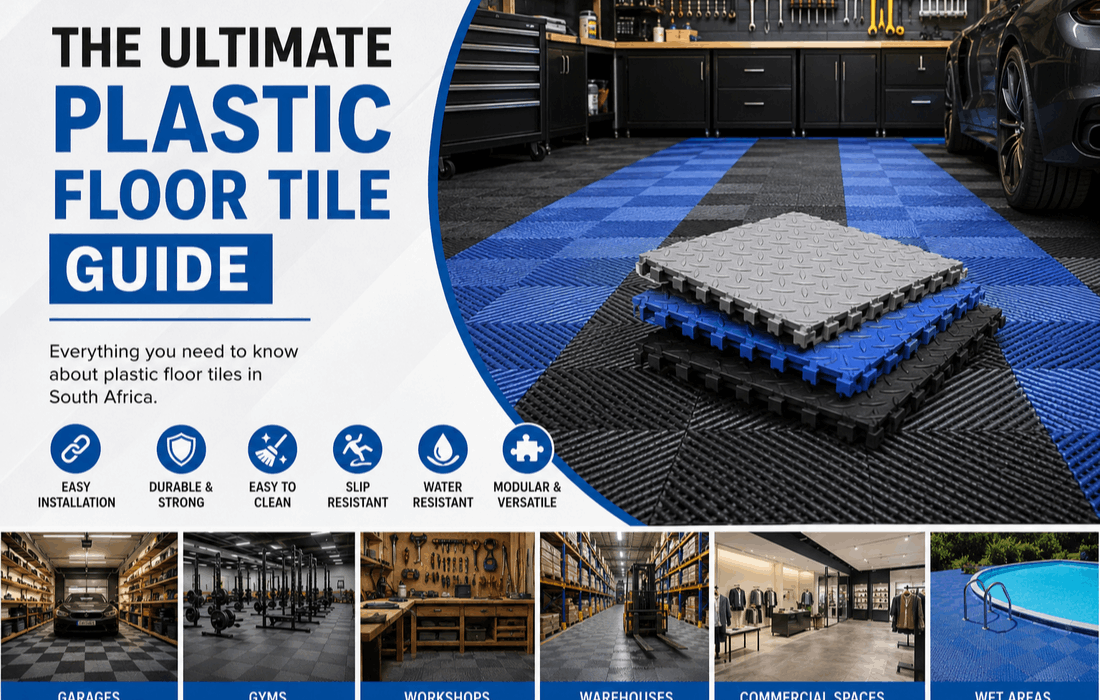
Plastic floor tiles are modular flooring products used to create practical surfaces in garages, workshops, factories, warehouses, commercial spaces and selected utility areas. This plastic floor tile guide South Africa explains how plastic tiles work, where they can be installed, their main benefits and what buyers should check before ordering. To see locally manufactured options and learn more about our flooring solutions, visit the PVC Floor Tile .
The term “plastic floor tile” can describe several types of modular flooring, but many heavy-duty indoor products are manufactured from PVC. These tiles are different from ceramic and porcelain because they are not brittle mineral tiles, and they are different from soft EVA foam because they are designed for firmer, more demanding applications.
A guide focused only on plastic flooring
This article concentrates on modular plastic floor tiles, especially interlocking PVC products. It does not compare ceramic, porcelain, carpet, timber or decorative household tiles in detail. This keeps the information relevant to buyers looking for practical plastic flooring for garages, workshops and working environments.
What Are Plastic Floor Tiles?
Plastic floor tiles are individual flooring sections manufactured from synthetic materials and connected or installed across an existing floor. Depending on the product, they may use visible puzzle-style joints, concealed connections or another modular locking design.
A plastic floor tile guide South Africa should make an important distinction between rigid decorative tiles and flexible interlocking PVC tiles. Interlocking plastic tiles are generally designed to create a continuous modular surface without requiring every piece to be permanently glued to the concrete.
The finished floor is formed by connecting multiple tiles together. Edges can be cut to fit around walls, columns, machinery, shelving and doorways. Different colours may also be combined to create borders, parking areas, work zones or walkways.
Plastic tiles are available in different sizes, thicknesses, surface textures and locking systems. These differences affect appearance, installation, maintenance and suitability for a particular environment.
What Are Plastic Floor Tiles Made From?
Many industrial and garage plastic tiles are manufactured from polyvinyl chloride, commonly called PVC. PVC can be formulated to produce a firm but slightly flexible flooring product that is suitable for modular tile construction.
Other plastic tile types may be manufactured from polypropylene or related materials. Polypropylene is often associated with harder, open-grid drainage tiles and modular sports surfaces. Buyers should therefore confirm the material instead of assuming that every plastic tile has the same properties.
PVC Interlocking Tiles
These tiles are commonly used in garages, workshops, factories, warehouses and commercial spaces. They often provide a firm, closed surface with visible or concealed interlocking edges.
Polypropylene Tiles
Polypropylene is commonly used for harder modular tiles, including selected drainage and sports flooring systems. Many designs contain openings that allow water to move through the surface.
Recycled Plastic Blends
Some products may contain recycled materials or a blend of new and recycled material. Product consistency, application and manufacturer specifications should be checked before purchase.
Flexible Plastic Compounds
Manufacturers can adjust material formulations to produce tiles with different levels of flexibility, hardness, surface grip and resistance to everyday use.
Common Types of Plastic Floor Tiles
The correct plastic tile depends on whether the floor needs a closed surface, drainage openings, a decorative pattern or a particularly strong connection system. The following categories are commonly considered for modular installations.
Visible Interlocking Tiles
Visible interlocking tiles have puzzle-style joints around their edges. The connection forms part of the floor’s appearance and can make installation straightforward because the adjoining pieces are aligned and pressed together.
This style is widely used in garages, workshops and commercial working areas. Different colours can be combined easily because the interlocking edge remains visible across the completed layout.
Hidden Interlocking Tiles
Hidden interlocking products are designed so that the connection is less visible once the floor has been installed. This can create a more continuous appearance while retaining the benefits of a modular tile system.
They may be suitable for customers who want an organised commercial or showroom-style finish without a highly visible puzzle pattern.
Coin Pattern Tiles
Coin pattern tiles feature raised circular details across the upper surface. The pattern creates a recognisable industrial and garage-floor appearance while adding texture to the tile.
The coin design can help make a garage, workshop or display area look structured and visually consistent. Cleaning requirements should be considered because textured areas may need attention around the raised pattern.
Diamond and Textured Tiles
Diamond, studded and other textured surfaces are used to create visual interest and additional surface detail. They are commonly chosen for garages, workshops and industrial-style interiors.
The selected texture should suit the cleaning routine and the type of trolleys or equipment that may move across the floor.
Vented Plastic Tiles
Vented plastic tiles contain openings that allow water and smaller debris to pass below the upper surface. They may be used in wash bays, wet garages, changing areas, pool surrounds or other spaces that require a raised drainage surface.
The original floor still needs a suitable slope and drainage route. Vented tiles allow water through the surface, but they do not remove it from the building.
Where Plastic Floor Tiles Can Be Used
This plastic floor tile guide South Africa focuses mainly on practical and commercial applications. Plastic flooring is frequently selected where buyers want modular coverage, easier installation and the ability to create colour-coded areas.
| Application | Suitable Plastic Tile Style | Main Considerations |
|---|---|---|
| Residential garage | PVC interlocking, coin pattern or textured tiles | Vehicle parking, tyre movement, cleaning and appearance |
| Workshop | Suitable heavy-duty PVC interlocking tiles | Tools, equipment, trolleys and work activities |
| Factory | Industrial modular PVC flooring | Machinery, traffic, production activities and maintenance |
| Warehouse | Heavy-duty plastic tile systems | Pedestrian routes, storage, trolleys and operational traffic |
| Commercial area | Hidden-joint or decorative modular plastic tiles | Customer traffic, appearance and cleaning |
| Car showroom | Coordinated PVC tile colours and patterns | Vehicle presentation, lighting and tyre use |
| Wash bay | Vented plastic drainage tiles | Water movement, drain position and subfloor slope |
| Storage room | Closed modular plastic tiles | Shelving, boxes, access routes and cleaning |
Main Benefits of Plastic Floor Tiles
Plastic flooring is often chosen because it combines modular installation with a finished, organised appearance. The benefits depend on the exact product, but several advantages are commonly associated with interlocking tile systems.
- Modular construction: Individual tiles connect to create a larger floor suited to different room dimensions.
- Flexible layouts: Colours can be arranged to create borders, parking bays, walkways and work zones.
- Installation around obstacles: Tiles can be cut and planned around columns, shelving, machinery and walls.
- Individual tile replacement: Depending on the system, a damaged section may be replaced without removing the entire floor.
- Finished appearance: Plastic tiles can improve the visual organisation of concrete garages and industrial spaces.
- Different surface patterns: Buyers can select coin, diamond, smooth, studded or other textured designs.
- Reduced reliance on wet adhesives: Many interlocking systems can be installed without permanently bonding every tile.
- Localised repairs: Modular construction may make access and repair easier than with some continuous floor coverings.
For available designs, colours and modular systems, explore our range of interlocking plastic flooring options.
Plastic Tiles Compared With Ceramic Tiles
Plastic and ceramic tiles serve different purposes. Ceramic tiles are hard, decorative products normally fixed with adhesive and grout. Plastic interlocking tiles are modular flooring units commonly used where practical installation, vehicle use or industrial activity is more important.
| Feature | Plastic Interlocking Tiles | Ceramic Tiles |
|---|---|---|
| Material | PVC, polypropylene or another plastic compound | Fired clay or ceramic material |
| Installation | Often connected through a modular locking system | Usually fixed with adhesive and finished with grout |
| Typical use | Garages, workshops, factories and commercial spaces | Kitchens, bathrooms and household interiors |
| Cutting | Cut according to the plastic product and installation instructions | Usually requires suitable tile-cutting equipment |
| Replacement | Individual sections may be replaceable | Damaged tiles may require grout and adhesive removal |
| Surface feel | Can have slight flexibility depending on formulation | Hard and rigid |
How to Choose the Correct Plastic Tile
A useful plastic floor tile guide South Africa should help buyers assess the room before choosing a colour or pattern. Product performance depends on how well the tile matches the environment.
Identify the Main Application
Decide whether the floor will be used for vehicle parking, factory work, storage, customer access, drainage or general workshop activity. The main use should guide the tile type.
Check the Expected Traffic
Consider people, parked vehicles, trolleys, machinery and rolling equipment. Confirm that the chosen product is intended for the expected level and type of use.
Inspect the Existing Concrete
Check for major cracks, uneven areas, loose material, active moisture concerns and drainage problems. Serious defects should be assessed before the new flooring is installed.
Confirm Tile Size and Coverage
Check the tile dimensions and the number of tiles needed per square metre. Do not calculate the order using the visual size of the product alone.
Choose a Suitable Thickness
Thickness should be selected according to the product design and intended application. A thicker tile is not automatically suitable for every environment.
Review the Connection System
Compare visible puzzle joints, hidden connections and drainage-style modular systems. The connection influences appearance, installation and future access.
Plan Edges and Doorways
Consider the finished floor height near garage doors, pedestrian entrances, ramps, steps and adjoining rooms. Suitable edging or transitions may be required.
How to Measure for Plastic Floor Tiles
Measure the length and width of the floor in metres, then multiply the two figures to calculate the square-metre area. For example, a room measuring five metres by four metres has a total area of twenty square metres.
Irregular rooms can be divided into smaller rectangular sections. Calculate each section separately and add the results together. Columns, fixed machinery and unusual wall angles should be marked on a basic floor plan.
Allow for cutting, irregular edges, possible layout changes and future replacement pieces. The suitable allowance depends on the shape of the room and tile pattern. Ordering only the exact calculated quantity may leave no spare pieces for difficult cuts.
Check the number of tiles per square metre
Tile coverage depends on the product dimensions. For example, a 500 × 500 mm tile covers one quarter of a square metre, meaning four tiles are normally required for one square metre before adding any allowance. Always confirm the dimensions of the exact product being ordered.
Installation Planning
Before installation, remove loose debris and clean the existing floor. The base should be stable enough for the selected modular system. Major unevenness can affect how the connections align and how the completed surface sits.
Plan the starting position before connecting the full floor. In a rectangular garage, installers may begin from a suitable wall or create a central reference line, depending on the product and intended border layout.
Lay out a small section first to check the direction of the tile pattern and the way colours will meet. This is especially important when creating parking bands, perimeter borders or contrasting work zones.
Cuts should be planned carefully around walls, columns and door frames. Follow the manufacturer’s instructions regarding expansion space, fixed edges, adhesive use and transitions.
Cleaning and Maintenance
Routine maintenance depends on the tile surface and the type of dirt produced in the area. Smooth and lightly textured tiles may be easier to wipe, while deep coin or diamond patterns may require more attention around raised details.
Loose dust and debris should be removed before wet cleaning. Spills should be addressed promptly using methods suitable for the product. Strong chemicals should not be used without confirming that they are compatible with the tile material.
In garages and workshops, inspect the floor beneath parked equipment and vehicles periodically. If individual sections can be removed, this may allow access to the subfloor for deeper cleaning or inspection.
Vented tiles require a different routine because dirt and water can move below the upper grid. Drains and channels should remain open, and the area beneath the tiles may need periodic cleaning.
Common Buying Mistakes
This plastic floor tile guide South Africa also helps buyers avoid decisions that can increase cost or produce an unsuitable floor.
Choosing by Appearance Alone
A colour or pattern may look attractive but still be unsuitable for vehicle traffic, factory work, drainage or rolling equipment.
Assuming All Plastic Is the Same
PVC, polypropylene and softer foam materials have different properties and typical applications. Confirm the material before buying.
Ignoring Tile Dimensions
Buyers sometimes compare individual tile prices without checking how many tiles are required to cover one square metre.
Ordering Without an Allowance
Cuts, irregular walls and future repairs may require extra pieces. Ordering only the exact measurement can delay the installation.
Covering Serious Floor Problems
Plastic tiles should not be used to hide active moisture, unstable concrete or major drainage issues without first addressing the cause.
Forgetting Finished Floor Height
A new modular surface can affect doors, ramps, equipment clearance and transitions to adjoining floors.
Frequently Asked Questions
Are plastic floor tiles the same as PVC tiles?
PVC tiles are a type of plastic floor tile. However, not every plastic tile is manufactured from PVC. Some modular drainage and sports tiles may be made from polypropylene or another material.
Can plastic tiles be installed in a garage?
Suitable interlocking PVC tiles are commonly used in garages. The selected product should be intended for vehicle use, and the existing floor should be inspected before installation.
Do plastic floor tiles require glue?
Many interlocking systems can be installed without permanently gluing every tile. However, adhesive may be recommended in selected areas or applications. Always follow the instructions for the specific product.
Can individual plastic tiles be replaced?
Depending on the locking system and installation method, individual damaged tiles or smaller sections may be replaceable without removing the complete floor.
Are plastic tiles suitable for wet areas?
Vented plastic tiles may be suitable for selected wet areas because their openings allow water to pass through. The subfloor still needs an effective drainage route.
How many 500 × 500 mm tiles are required per square metre?
Four 500 × 500 mm tiles normally cover one square metre. Additional tiles may be required for cuts, irregular edges and future replacement.
Choose Plastic Tiles According to the Application
The purpose of this plastic floor tile guide South Africa is to help buyers understand modular plastic flooring without confusing it with ceramic tiles, rubber gym flooring or soft foam mats. Plastic interlocking tiles can provide practical coverage for garages, workshops, factories, warehouses, showrooms and storage areas when the correct product is matched to the environment.
Begin with the intended use, traffic level and condition of the existing floor. Then compare the tile material, size, thickness, connection style, surface pattern and installation requirements. A carefully planned system can improve the appearance of a working space while creating clear parking, storage and movement zones.
General Information About Polyvinyl Chloride
For general background about the material commonly used to manufacture flexible plastic flooring products, read the Wikipedia overview of polyvinyl chloride .
Need Help Choosing Plastic Floor Tiles?
Share your floor dimensions, intended use, vehicle or equipment requirements and preferred tile design with PVC Floor Tile. Our team can help you compare suitable modular flooring options for garages, workshops, factories and commercial areas.
Contact Our Flooring Team