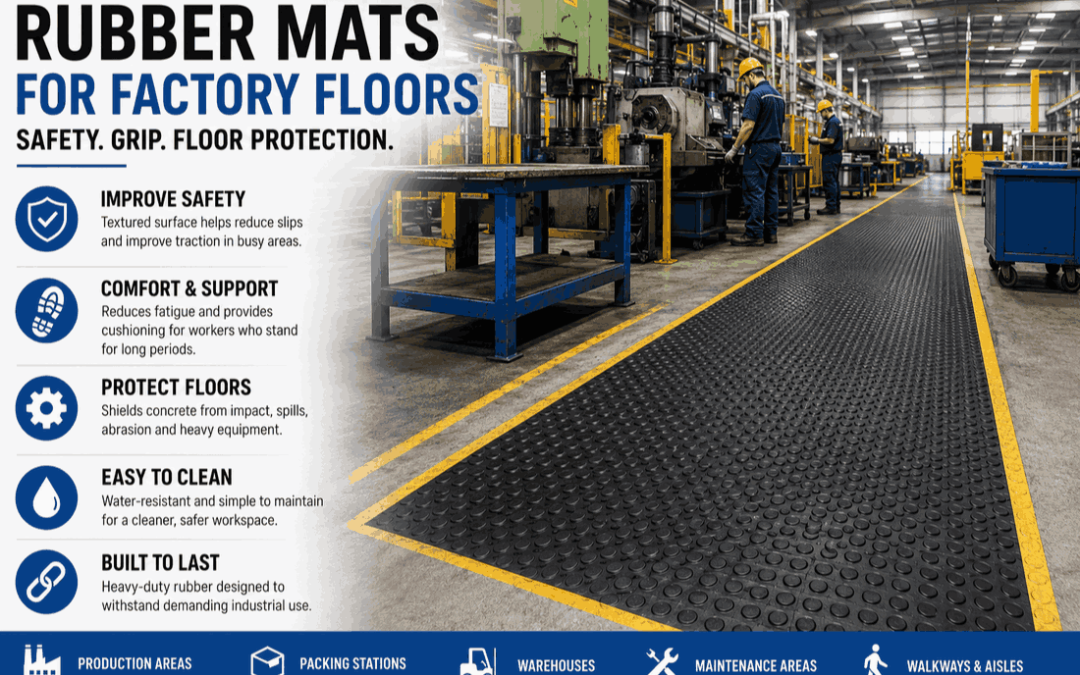
Rubber mats for factory floors can provide localised grip, underfoot support and surface protection around production stations, machinery points, packing areas and selected staff routes. They are most useful where a factory needs targeted coverage rather than a complete wall-to-wall flooring replacement. Explore our industrial rubber mats for defined factory work zones, entrances and floor-protection applications.
Factory floors operate under demanding conditions. Workers move continuously between stations, tools and components may be dropped, trolleys cross busy areas and machinery places repeated pressure on the supporting surface.
Individual rubber mats can help protect selected high-use sections without requiring the business to cover every square metre. However, their suitability depends on the exact material, thickness, texture, dimensions and intended application.
This guide focuses specifically on localised factory matting. It does not replace the need for a properly planned industrial floor where an entire production room requires continuous coverage.
Where do factory rubber mats work best?
Factory mats generally work best at defined workstations, packing points, maintenance areas, selected entrances and smaller machine zones. For an entire production floor, a continuous or modular factory-flooring system may be more practical.
Why Use Rubber Mats in Selected Factory Areas?
Not every section of a factory experiences the same type of pressure. One area may involve standing work, another may receive regular trolley movement and another may be exposed to dropped tools or production debris.
Using mats in selected locations allows a facility to match the floor covering to the activity taking place in that zone. This is different from choosing one broad flooring solution for the complete building.
Localised protection
Protect the sections that receive concentrated daily use without covering unrelated floor areas.
Defined work zones
Use individual mats to identify workstations, operator positions and maintenance points.
Sectional replacement
Replace a compatible individual section when localised wear or damage occurs.
Rubber Mats for Factory Floors and Surface Protection
Concrete, coatings and existing tiles can develop chips, stains, scratches or concentrated wear when tools, stock and equipment repeatedly contact the same floor sections.
A suitable mat creates a separation layer between the activity and the supporting floor. It may help reduce direct contact from ordinary foot traffic, movable equipment and minor impacts.
The mat should still be matched to the load and activity. A lightweight entrance mat should not automatically be used beneath machinery simply because both products are made from rubber.
Important product distinction: Entrance mats, anti-fatigue mats, drainage mats, solid rubber mats and interlocking rubber tiles have different designs. Confirm the intended application before ordering.
Best Factory Areas for Localised Rubber Matting
The correct starting point is to map the factory according to work activity. Identify where people stand, where tools are handled, where goods are packed and where maintenance work regularly takes place.
| Factory area | Main requirement | Possible role of rubber mats |
|---|---|---|
| Assembly station | Underfoot support and defined working space | Position a mat at the fixed operator zone. |
| Packing area | Coverage where staff stand repeatedly | Use mats at individual packing and quality-control points. |
| Tool station | Protection from concentrated tool handling | Cover the floor directly in front of the workbench. |
| Machine service point | Access and localised floor protection | Use a suitable mat where routine operator or maintenance work occurs. |
| Factory entrance | Dirt and moisture control | Select an entrance-specific mat rather than general-purpose factory matting. |
| Short staff route | Defined walking surface | Use secured matting only where edges and movement can be controlled. |
Production-Line Operator Stations
Operators may spend much of a shift in one defined position. A correctly selected mat can create a more forgiving surface than bare concrete while also marking the expected standing zone.
The mat should fit the workstation without extending into trolley routes, machine access points or emergency paths. Exposed edges must remain visible and stable.
Where the complete production line requires continuous coverage, individual mats may create too many edges. In that case, the facility should evaluate a broader flooring system.
Packing, Sorting and Inspection Areas
Packing and sorting stations often involve repeated standing, turning and short movements. Separate mats may suit clearly divided workstations where each person has a defined working position.
Measure the usable floor space before ordering. The mat should be large enough for ordinary movement but should not interfere with cartons, pallet handling, wheeled equipment or nearby staff routes.
Check the workstation
- Normal standing position
- Turning and reaching movement
- Nearby tables or conveyors
- Trolley access
- Floor-level changes
- Cleaning access
Check the mat
- Dimensions and thickness
- Surface texture
- Edge design
- Movement on the supporting floor
- Material compatibility
- Supplier cleaning guidance
Machinery and Equipment Service Zones
A mat may be useful at the operator or maintenance side of selected equipment. Its purpose should be clearly defined: underfoot coverage, floor protection or creating a designated service position.
Do not place a general mat beneath heavy machinery without confirming load suitability. Equipment weight, vibration, heat, sharp components and oils can affect whether the product is appropriate.
Do Not Select Factory Mats by Appearance Alone
Two rubber products may look similar while having different dimensions, density, thickness and intended applications. Compare the technical details and expected use rather than choosing only according to colour or surface pattern.
Rubber Mats for Tool Rooms and Maintenance Areas
Tool rooms contain concentrated workstations, storage systems and equipment-handling points. Localised matting may help protect the area immediately in front of a bench or service station.
For a more detailed discussion about these specific environments, read our guide to rubber mats for workshops and tool rooms.
That article focuses on workshop and tool-room use, while this factory guide remains centred on production facilities and defined industrial work zones.
Factory Walkways and Staff Movement Routes
Individual mats are not automatically the best choice for a long factory walkway. Multiple loose sections can create more edges, movement points and cleaning requirements.
A shorter defined route may use suitable matting where sections can be kept aligned and secure. Longer routes often benefit from a continuous or connected flooring format with fewer exposed edges.
Cannibalisation and product distinction: This article covers mats for selected factory zones. For complete production floors, larger walkways and connected industrial areas, review our complete factory flooring solutions.
Grip and Slip-Risk Management
Textured rubber surfaces may support underfoot grip, but no mat can make a factory floor completely slip-proof. Dust, oils, loose particles, moisture and cleaning residue can still affect the surface.
The factory should combine suitable flooring with housekeeping, spill response, inspections and clear walking routes. A mat that has accumulated grease or production debris may perform differently from a clean, properly maintained surface.
Factory slip-risk controls should include:
- Prompt spill removal
- Regular sweeping
- Suitable cleaning products
- Clear pedestrian routes
- Inspection of mat edges
- Replacement of damaged sections
- Correct mat selection
- Good entrance dirt control
- Staff reporting procedures
- Dry storage of cleaning equipment
Choosing the Correct Surface Texture
Surface texture affects cleaning, movement and how the mat feels underfoot. Raised patterns may offer additional surface contact, but grooves can also retain dust and production residue.
The factory should balance grip requirements with the need for practical maintenance. A highly textured mat may require more detailed brushing than a flatter surface.
Smoother surfaces
May be simpler to sweep, but application and grip requirements must still be checked.
Raised patterns
Can provide a defined texture but may hold dirt between raised sections.
Open drainage designs
May suit selected wet zones but are different from solid general-purpose mats.
Choosing Rubber Mat Thickness
Thickness should be selected according to the activity, floor condition and expected load. A thicker product is not automatically suitable for every factory application.
A simple staff standing point may have different requirements from a tool station or equipment service area. Very thick mats can also create higher transitions that require careful edge management.
| Selection factor | Why it matters |
|---|---|
| Worker activity | Standing, walking and turning place different demands on a mat. |
| Equipment load | The product must be suitable for any pressure placed directly on it. |
| Exposed edge height | Thicker products create a greater transition from the supporting floor. |
| Cleaning method | The thickness and texture may affect lifting, washing and drying. |
| Supporting surface | Smooth, damaged or uneven floors can affect mat stability. |
| Replacement availability | Matching dimensions are important when one section needs replacement. |
Edge Control and Mat Movement
One of the most important maintenance responsibilities is checking whether mats remain flat and correctly positioned.
Repeated walking, turning, machinery vibration or trolley contact may cause loose sections to shift. Raised or curled edges should not be ignored.
Inspect for:
- Curling corners
- Movement from the original position
- Gaps between sections
- Damaged edges
- Debris trapped underneath
- Uneven transitions
Respond by:
- Closing the affected section where necessary
- Cleaning the supporting surface
- Checking product compatibility
- Following the installation guidance
- Replacing damaged mats
- Reviewing the surrounding traffic route
Cleaning Industrial Rubber Floor Mats
Factory matting should form part of the ordinary housekeeping schedule. Loose grit, metal fragments, packaging waste and production debris can collect on textured surfaces or around edges.
Sweep first before applying water. Use a cleaner approved for the exact rubber product and remove any cleaning residue before the area returns to service.
Where mats can be lifted safely, inspect the floor beneath them. Trapped dirt or liquid can affect hygiene, odour and mat stability.
Factory mat maintenance checklist:
- Remove loose debris daily
- Clean spills promptly
- Use compatible cleaning products
- Avoid unapproved solvents
- Inspect all exposed edges
- Check for movement
- Clean beneath loose mats
- Record damaged sections
- Replace incompatible patches
- Keep pedestrian routes clear
Oil, Grease and Production Residue
Do not assume every rubber mat is resistant to oils, fuels, chemicals or industrial cleaning agents. Material compatibility varies between products.
Spills should be controlled quickly according to the factory’s safety procedures. The contaminated section may need to be isolated until it has been cleaned and inspected.
Check Chemical Compatibility Before Ordering
Send the supplier information about substances likely to contact the floor. General descriptions such as “heavy duty” do not confirm resistance to a particular oil, solvent, chemical or production process.
When Individual Factory Mats Are Not Enough
Localised mats are useful where the flooring requirement is concentrated in selected zones. They may become less practical when the entire production area requires uninterrupted coverage.
A broader factory-flooring system may be more appropriate when:
- The complete room requires floor protection.
- Long connected walkways must be covered.
- Numerous individual mats would create too many edges.
- The layout changes frequently across a large area.
- Wheeled movement crosses the complete floor.
- A connected modular appearance is preferred.
- Cleaning around separate sections would be difficult.
- Floor damage extends across the full room.
This distinction keeps the role of this article clear: it helps factories select mats for individual zones, while the Factory Flooring collection supports complete flooring projects.
How to Plan Factory Mat Placement
Map the activity
Identify standing stations, machine access points, entrances, packing areas and pedestrian routes.
Inspect the supporting floor
Check concrete condition, coatings, moisture, uneven areas and existing damage.
Define the mat purpose
Decide whether the main requirement is underfoot support, surface protection, dirt control or drainage.
Confirm the exact specification
Check dimensions, thickness, material, texture, edge design, cleaning and installation guidance.
Common Factory Mat Selection Mistakes
| Mistake | Better approach |
|---|---|
| Choosing only by price | Compare application, dimensions, material and expected daily use. |
| Using one mat type everywhere | Select products according to the requirements of each factory zone. |
| Ignoring exposed edges | Plan transitions and inspect mat movement regularly. |
| Assuming universal chemical resistance | Confirm compatibility with oils, cleaners and production substances. |
| Covering long routes with loose sections | Consider connected or continuous flooring for larger walkways. |
| Forgetting maintenance access | Choose a format that staff can clean and inspect properly. |
Workplace Slip and Trip Guidance
Factory floor planning should consider contaminants, cleaning procedures, pedestrian movement, transitions and the condition of the supporting surface.
For additional general information, visit the Health and Safety Executive slips and trips guidance website. South African facilities should also follow applicable workplace requirements and the instructions supplied for the exact flooring product.
Frequently Asked Questions
Are rubber mats suitable for every factory area?
No. Suitability depends on the activity, load, substances present, supporting floor and product specification.
Can factory mats cover a complete production floor?
Individual mats may cover selected sections, but a continuous or connected flooring system may be more practical for complete rooms.
Do rubber mats prevent all slips?
No floor covering eliminates every slip risk. Cleaning, spill response, inspection and good housekeeping remain necessary.
Can factory mats be placed beneath machinery?
Only when the exact product is suitable for the equipment load, vibration, heat and substances likely to contact it.
How often should factory mats be inspected?
Busy areas should receive frequent visual checks, with more detailed inspections included in the facility’s maintenance schedule.
Final Advice on Rubber Mats for Factory Floors
Rubber mats for factory floors are most useful when a business needs targeted coverage around operator stations, packing points, maintenance areas, selected equipment zones and shorter staff routes.
Their main advantage is flexibility: a factory can protect individual high-use sections without necessarily replacing the entire floor. However, every mat should be selected according to its actual application rather than relying on a broad heavy-duty description.
Measure each zone, inspect the supporting surface and consider traffic, equipment, contaminants, cleaning and exposed edges before ordering.
Where the entire production room requires continuous protection, move beyond individual mats and assess a properly planned factory-flooring system.
Need Help Selecting Factory Rubber Mats?
PVC Floor Tile supplies rubber mats and modular flooring options for production stations, packing areas, machine zones, tool rooms and industrial workspaces across South Africa. Send our team your dimensions, photographs, project location and details of the activity taking place in each area.
Contact Us