
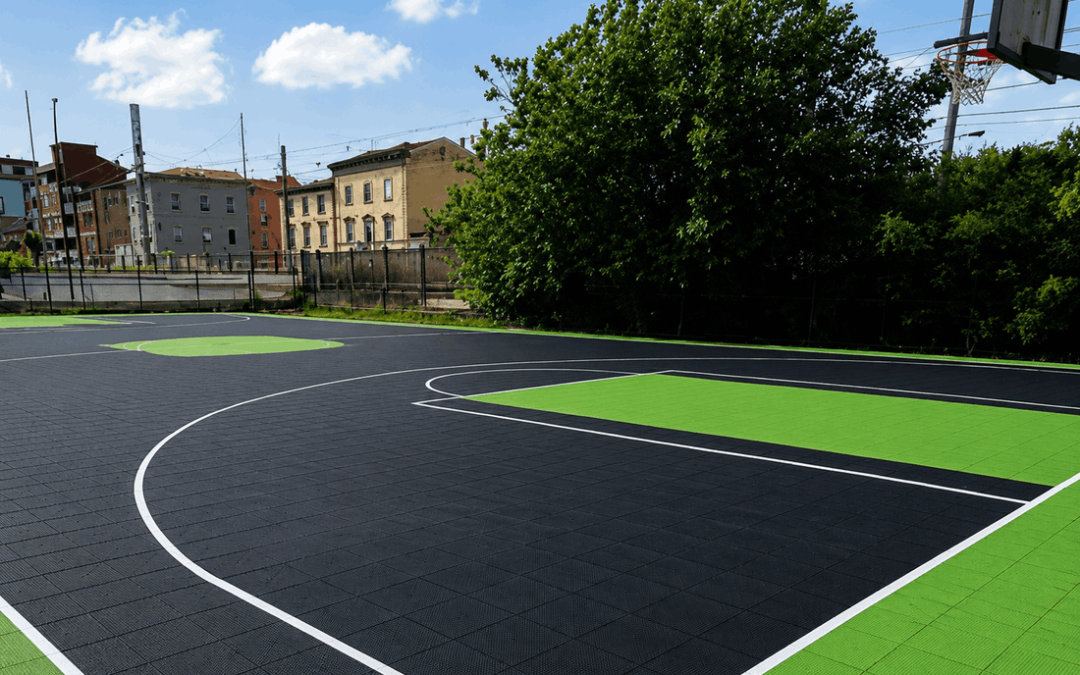
Modular sports tiles are interlocking flooring sections designed to create flexible court surfaces for schools, clubs, recreation areas and outdoor sports facilities. Their sectional construction can make installation, maintenance and selected tile replacement easier than some permanently bonded surfaces. The final result still depends on choosing a tile designed for the intended environment and installing it over a suitable base. Explore our modular flooring for outdoor courts.
Outdoor courts need to handle more than player movement. The surface may also be exposed to rain, direct sunlight, dust, leaves, temperature changes and repeated cleaning.
This guide explains how modular sports tiles work, whether they are suitable for outdoor courts and which advantages, limitations and installation requirements should be considered before choosing modular court flooring.
What Are Modular Sports Tiles?
Modular sports tiles are individual flooring sections that connect together to form a larger sports surface. The edges usually contain interlocking connectors that help keep the tiles joined during normal use.
Instead of installing one continuous sheet or coating, the court is assembled from repeatable tile units. This allows different colours to be combined for playing zones, borders, walkways and court markings.
Modular sports tiles may provide:
- Interlocking installation
- Flexible colour layouts
- Sectional tile replacement
- Access to selected floor areas
- Defined court zones
- Installation over suitable concrete
- Indoor or outdoor options
Before choosing tiles, confirm:
- The intended sport
- Indoor or outdoor use
- The base-floor condition
- Drainage requirements
- Expected traffic
- Tile connection design
- Maintenance requirements
How Interlocking Sports Tiles Connect
Interlocking sports tiles use connectors around the edges. When adjoining tiles are pressed together, the connectors form a continuous modular surface.
A good installation depends on accurate alignment and enough perimeter space for the system. The court edges should be planned carefully so that tiles remain contained without blocking drainage routes.
Prepare the base
Clean the existing surface and address serious cracks, loose sections and major low spots.
Plan the layout
Confirm court dimensions, colours, playing zones and the starting position before connecting tiles.
Connect the tiles
Align each modular section and engage the connectors according to the supplier’s installation method.
Why the Modular System Matters
The main advantage is not only the appearance of the court. The modular design can make selected sections easier to inspect, adjust and replace when compared with a surface that functions as one permanently bonded layer.
Are Modular Sports Tiles Good for Outdoor Courts?
Modular sports tiles can be suitable for outdoor courts when the product is specifically designed for exterior use and installed over a stable, correctly prepared base.
Outdoor suitability should never be assumed. The tile material, connection system, drainage design and supplier specifications should all match the intended environment.
Outdoor modular tiles should be assessed for:
- Rain and moisture exposure
- Direct sunlight
- Temperature changes
- Drainage through or around the surface
- Regular outdoor cleaning
- Dust, leaves and mud
- Expansion and perimeter planning
Benefits of Modular Sports Tiles for Outdoor Courts
A modular court can provide practical benefits for schools, clubs and community facilities. The interlocking design allows the flooring to be installed in sections and arranged according to the required court layout.
Where individual tiles become damaged, the modular design may allow a selected section to be removed and replaced without rebuilding the entire court.
Installation benefits:
- Repeatable modular sections
- Planned colour combinations
- Clear court borders
- Defined activity zones
- Suitable for court upgrades
- Can cover an older stable base
Maintenance benefits:
- Selected tiles can be inspected
- Damaged sections may be replaceable
- Joints can be checked individually
- Sections may be lifted when necessary
- Cleaning access may be improved
- Wear can be monitored by zone
Sectional Replacement of Damaged Tiles
One of the strongest advantages of modular sports tiles is the potential to replace a damaged section rather than the entire floor.
This can be useful where damage is limited to one court entrance, high-traffic area or equipment zone. The replacement tile should match the existing size, colour, connection system and product specification.
Important: Before replacing a damaged tile, check why it failed. Repeated damage in one location may indicate an uneven base, perimeter pressure or installation problem underneath the surface.
Flexible Court Colours and Layouts
Modular court flooring can be planned using different tile colours. This allows facilities to create borders, central playing zones, goal areas, run-off sections or separate activity spaces.
Schools and community centres may also use colour to organise a multi-purpose court. However, the layout should remain clear and not become overcrowded with too many colours or markings.
Colour planning can help define:
- Main playing zones
- Court borders
- Goal or key areas
- Training sections
- Walkways
- Multi-sport zones
- Facility branding colours
Modular Court Flooring Over Concrete
Concrete is a common base for modular sports flooring because it can provide a firm and stable foundation. However, the slab must still be inspected before installation.
Large cracks, loose concrete, significant height changes and deep low spots may affect the court. Outdoor bases must also allow water to move toward the correct drainage point.
A suitable base should be:
- Firm and stable
- Clean before installation
- Free from loose sections
- Reasonably level
- Properly sloped outdoors
- Clear of drainage blockages
Assess the base when it has:
- Moving structural cracks
- Deep depressions
- Standing water
- Crumbling concrete
- Large uneven repairs
- Water flowing toward buildings
Drainage and Modular Outdoor Tiles
Outdoor modular tiles may use an open-grid structure that allows water to move through the upper surface. Water then reaches the supporting base and follows its slope toward a drain or court edge.
The modular tile does not create the base slope. If the concrete underneath contains low spots or blocked outlets, water may remain below the tiles.
For more detail about vented tile construction, read our guide to open-grid court tiles for drainage.
Do Modular Tiles Need Expansion Space?
Outdoor flooring materials may react to temperature changes. The installation should therefore follow the supplier’s instructions for perimeter clearance, edging and expansion planning.
Installing the tiles too tightly against walls, kerbs or fixed structures may place pressure on the court as conditions change. Too much uncontrolled space may also leave the edges vulnerable.
Perimeter planning should consider:
- Supplier expansion requirements
- Fixed walls and kerbs
- Drainage routes
- Ramps and edge strips
- Fencing posts
- Entrances and gates
- Nearby structures
Inspecting Interlocking Tile Joints
The joints between modular tiles should be inspected during routine court maintenance. Look for separation, lifting, broken connectors and movement under foot traffic.
High-use sections such as entrances, central court zones and equipment areas may need more frequent inspection than quiet perimeter sections.
Inspect visually
Look for separated seams, raised corners and changes in alignment.
Check movement
Confirm that tiles remain stable during normal walking and court activity.
Repair early
Reconnect or replace damaged sections before the problem spreads to nearby tiles.
Cleaning Modular Sports Tiles
Outdoor modular sports tiles should be swept regularly to remove leaves, dust and loose dirt. Open-grid designs also need clear surface openings and drainage routes.
Use cleaning methods and products recommended by the supplier. Harsh solvents, oily cleaners and floor polishes may affect the tile surface or create residue.
Basic modular court maintenance includes:
- Sweeping loose debris
- Clearing drainage openings
- Removing mud before it hardens
- Inspecting perimeter areas
- Checking modular connectors
- Cleaning spills promptly
- Replacing damaged tiles when required
Modular Tiles for Schools
Schools may use outdoor courts for physical education, break-time activity, after-school training and several different sports. Modular sports tiles can help organise these shared areas through colour zones and clear court layouts.
The surface should be chosen according to learner traffic, the sports played, outdoor exposure and available maintenance staff.
School benefits may include:
- Clear multi-use court zones
- Replaceable damaged sections
- Bright colour combinations
- Outdoor drainage options
- Defined activity areas
- Manageable routine maintenance
Schools should confirm:
- Age groups using the court
- Daily learner numbers
- Base condition
- Outdoor drainage
- Cleaning responsibilities
- Court-line requirements
Modular Tiles for Clubs and Community Courts
Club and community courts may host training, organised matches, public recreation and group fitness. A modular surface can help create a defined sports area while allowing selected sections to be maintained separately.
Busy facilities should monitor entrances, sidelines and equipment zones because these locations may experience concentrated traffic.
Can a Modular Court Be Expanded Later?
In some cases, a modular court may be extended or adjusted by adding compatible tiles. This depends on the available base, matching product supply and the original connection system.
A future extension should use the same tile specification where possible. Differences in size, thickness or connector design may prevent two systems from joining correctly.
Planning tip: Keep a record of the tile model, size, colour and supplier after installation. This can make future replacement or court expansion easier.
Limitations of Modular Sports Tiles
Modular sports tiles are practical, but they are not suitable for every location or every sport. Specialist competition facilities may require certified systems designed for particular sporting standards.
The modular floor also depends heavily on the condition of the base. Installing tiles over serious structural damage does not correct the underlying problem.
Modular tiles work best when:
- The base is stable
- The product suits outdoor use
- Drainage is properly planned
- The court is maintained regularly
- Perimeter space is provided
- The intended sport is suitable
They may not solve:
- Structural concrete movement
- Severe drainage failure
- Deep low spots
- Blocked stormwater outlets
- Incorrect specialist-sport requirements
- Unstable supporting ground
Common Mistakes When Choosing Modular Court Flooring
One common mistake is choosing modular sports tiles only by colour without confirming whether the product is suitable for outdoor use.
Another mistake is installing the tiles over a damaged or poorly drained base and expecting the modular surface to correct the problem.
Avoid these mistakes:
- Using indoor-only tiles outdoors
- Ignoring the existing base
- Blocking drainage at the edges
- Installing tiles too tightly
- Mixing incompatible tile systems
- Failing to inspect joints
- Choosing flooring only by appearance
Are Modular Sports Tiles Worth It?
Modular sports tiles can be a practical choice for outdoor courts where flexible installation, planned colours and sectional replacement are important.
Their value depends on the quality of the tile, suitability for the environment, correct base preparation and ongoing maintenance. A modular system should be treated as part of the full court design rather than a shortcut around drainage or structural repairs.
For schools, clubs and community courts with suitable bases, modular court flooring can provide a clean, organised and manageable sports surface.
Final Advice on Modular Sports Tiles
Modular sports tiles can work well on outdoor courts when the product is designed for exterior conditions and installed over a firm, properly drained base.
The interlocking system can support flexible layouts, colour zoning and selected tile replacement. However, the court still needs correct perimeter planning, drainage, cleaning and regular joint inspections.
Before choosing a system, confirm the intended sport, court size, base condition, outdoor exposure and long-term maintenance plan.
For broader surface-management guidance, refer to the Health and Safety Executive guidance on preventing slips and trips.
Contact Us About Modular Sports Tiles
PVC Floor Tile supplies modular sports flooring for schools, clubs, recreation facilities, community courts and outdoor training areas across South Africa. Send our team the court dimensions, photographs of the existing base and details of the sports planned for the area so we can help you identify a suitable flooring option.
Contact Us