
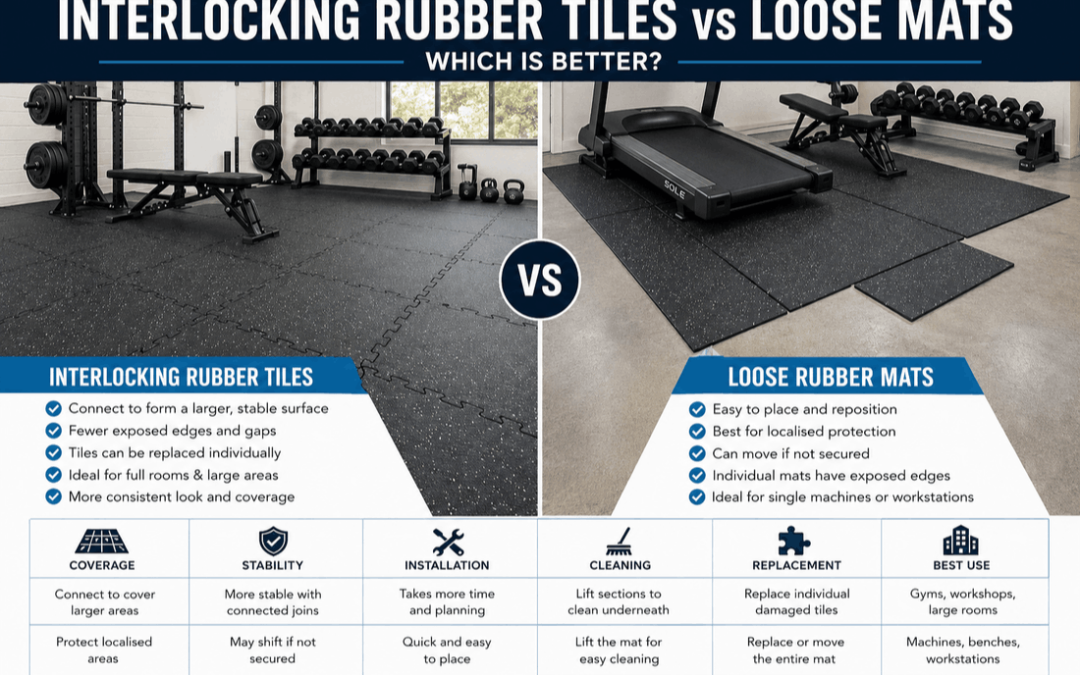
Interlocking rubber tiles vs loose mats is an important comparison when a gym, workshop, equipment room or commercial space needs reliable floor protection. Connected tiles create a wider modular surface, while loose mats normally protect one localised area and remain independent from surrounding flooring. Compare our connected interlocking rubber tiles when planning a complete room or larger protected zone.
The connected format can reduce the number of exposed internal edges and may help the flooring remain aligned across a wider area. Individual damaged tiles may also be replaceable without removing the complete floor.
Loose mats still have an important purpose. A mat may be quicker to position beneath one treadmill, workbench, machine or standing workstation, especially when full-room coverage is unnecessary.
The correct choice depends on the area size, equipment, traffic, cleaning requirements, supporting floor and whether the flooring must remain easy to reposition.
Interlocking Rubber Tiles vs Loose Mats: Which Is Better?
Connected tiles are generally more practical when a larger area needs consistent modular coverage, fewer exposed internal edges and replaceable individual sections. Loose mats may be better when protection is required beneath only one machine, bench or workstation.
What Are Interlocking Rubber Tiles?
Interlocking rubber tiles are modular flooring sections with puzzle-style or concealed connections around their edges. The joins allow neighbouring tiles to function as part of one wider surface.
They can be used for complete rooms or defined zones. Common applications include home gyms, commercial fitness spaces, workshops, equipment rooms, schools and community facilities.
Some installations can remain loose-laid, while others may need perimeter securing or adhesive. The correct method depends on the product, room size, open edges, equipment and traffic.
What Are Loose Rubber Mats?
Loose mats are individual sections placed directly over an existing floor. They may have straight, bevelled or moulded edges and usually do not connect to neighbouring mats.
They are useful for local protection beneath one item or in one standing area. A loose mat can often be lifted, repositioned or replaced quickly.
Browse loose rubber mats for localised protection when the complete room does not need to be covered.
Interlocking tiles are commonly used for
- Full-room gym coverage
- Larger training zones
- Workshop floor sections
- Community fitness rooms
- School weight rooms
- Commercial equipment areas
Loose mats are commonly used for
- One exercise machine
- Individual workbenches
- Standing workstations
- Small equipment zones
- Temporary floor protection
- Movable training stations
Connected Coverage Across Larger Areas
A major difference is the way the separate pieces relate to one another. Interlocking tiles connect across each row, while loose mats remain independent.
In a larger room, connected flooring can create a more unified appearance. It can also simplify equipment placement because there are fewer separate mat boundaries across the floor.
Loose mats may leave several exposed edges when multiple mats are positioned next to one another. These gaps and boundaries may collect dirt or move out of alignment.
Important: Interlocking joins may improve overall alignment, but they do not guarantee that the floor will never move. Product design, perimeter conditions, traffic and equipment still matter.
Stability Under Foot Traffic
Individual mats may shift when users step near an edge, turn quickly or move equipment across the surface. The amount of movement depends on the mat weight, backing, supporting floor and activity.
When comparing interlocking rubber tiles vs loose mats, connected sections may provide greater overall stability because each tile is supported by neighbouring sections instead of moving independently.
However, open perimeter edges and busy doorways may still require suitable ramps or additional securing. Joins should also be inspected regularly.
Exposed Edges and Transition Points
Every individual loose mat has its own perimeter. Where several mats are used, this can create multiple exposed boundaries across a room.
Interlocking flooring normally concentrates the exposed edges around the outside of the completed zone. Suitable ramps, border tiles or transition strips can then be fitted at those points.
No exposed edge should be ignored in a regular walking route. Loose, raised or curled edges should be corrected promptly.
Direct Flooring Comparison
| Feature | Interlocking rubber tiles | Loose rubber mats |
|---|---|---|
| Coverage | Connect to form a larger modular floor. | Protect individual localised areas. |
| Movement | Connected sections may reduce independent movement. | Each mat can shift separately. |
| Exposed edges | Mainly around the outside perimeter. | Every mat has its own perimeter. |
| Installation | Requires measuring, layout and joining. | Usually quicker to position. |
| Replacement | Individual tiles may be replaceable. | The complete mat can be moved or replaced. |
| Cleaning underneath | Several tiles may need to be lifted. | The mat can normally be lifted directly. |
| Room flexibility | Creates a more established floor layout. | Easy to reposition when the room changes. |
| Best application | Complete rooms and wider activity zones. | One machine, bench or workstation. |
Full-Room Flooring Versus Localised Protection
The size of the area is often the clearest deciding factor. A single treadmill or standing workstation may need only one suitable mat.
A gym containing racks, benches, free weights and cardio machines may benefit from a connected floor across the complete training area.
Interlocking flooring can support future layout changes within the covered zone. Equipment can be repositioned without exposing patches of unprotected concrete between individual mats.
Equipment Stability and Pressure Points
Neither tiles nor mats should be selected by appearance alone. Heavy machines can transfer their weight through small feet, creating concentrated pressure.
The rubber must remain firm enough to support the equipment without excessive compression. Suitable load-distribution pads may be required beneath narrow feet.
A connected floor does not automatically increase the structural strength of the room or guarantee equipment stability. The supporting floor and product specification must still be checked.
Gyms and Weight-Training Areas
The interlocking rubber tiles vs loose mats decision often favours connected tiles where several gym stations occupy one room. Connected flooring can cover walking routes between equipment and create one organised training surface.
Loose mats may remain suitable beneath an individual treadmill, exercise bike or compact bench where the surrounding floor does not need protection.
Repeated barbell or dumbbell impact requires special attention. Thin general-purpose tiles and mats should not automatically be used for heavy weight dropping.
One machine
A suitably sized loose mat may provide enough local protection beneath one treadmill or bike.
Several activity zones
Interlocking flooring may create more consistent coverage between machines, racks and benches.
Higher-impact use
Specialist thicker rubber or an impact-rated lifting surface may be required.
Workshops and Workbench Areas
A loose mat may be suitable where one person stands at a fixed workbench and the surrounding concrete needs to remain uncovered.
When assessing interlocking rubber tiles vs loose mats for workshops, connected flooring may be better where several benches, cabinets and pedestrian routes require wider coverage.
Rubber composition should be checked where oils, solvents, heat or other workshop substances may contact the floor. Chemical resistance varies between products.
Garage and Storage Areas
Loose mats can provide targeted protection beneath shelves, tool cabinets or workstations. They can also be lifted when the garage layout changes.
Interlocking tiles may suit larger storage or utility sections where people regularly walk between equipment and shelving.
Do not assume that general rubber tiles or mats are suitable beneath parked vehicles, hot tyres or automotive fluids. Vehicle suitability must be confirmed for the exact product.
School and Community Fitness Rooms
Shared facilities may contain several activity zones and receive more daily users than private rooms. Connected flooring can provide a defined surface for cardio, resistance and supervised training.
Loose mats may be useful beneath individual machines or temporary exercise stations, but multiple unsecured mats may require frequent repositioning.
Facility managers should inspect joins, edges and equipment areas regularly and keep spare flooring sections where possible.
Installation Time and Room Preparation
Loose mats are normally quicker to position because they do not need to be connected across the room. Measure the equipment footprint, place the mat and confirm that the edges remain flat.
Interlocking tiles require more planning. The room should be measured, the supporting floor cleaned and several rows dry-laid before perimeter pieces are cut.
Read our guide to installing modular rubber tiles over concrete before beginning a complete-room project.
Loose-Laid and Secured Installations
Both formats may be installed without permanent adhesive in selected situations. This does not mean that every room should remain completely loose-laid.
Open edges, large areas, rolling equipment and turning movement may require additional securing. The installation method should follow the instructions for the exact product.
Use only adhesives or tapes confirmed as compatible with the rubber and supporting floor.
Cleaning Above and Beneath the Flooring
Loose mats are usually easier to lift when the supporting floor needs to be cleaned. This can be useful in small equipment or work areas.
A connected floor may require several tiles to be lifted from the nearest accessible edge. This takes longer but may not be necessary during routine surface cleaning.
Sweep or vacuum loose grit before damp cleaning. Avoid excessive water, strong solvents and oily cleaning residue.
Cleaning connected tiles
- Vacuum joins and perimeter edges
- Use controlled damp cleaning
- Inspect separated connections
- Lift sections where moisture is trapped
- Replace damaged individual tiles
Cleaning loose mats
- Clean the complete top surface
- Lift and clean underneath
- Allow both surfaces to dry
- Check for curled edges
- Return the mat to its correct position
Replacing Damaged Flooring Sections
One advantage of modular tiles is the possibility of replacing one damaged section. The surrounding floor may need to be lifted from the nearest edge to release the tile.
With a loose mat, the entire mat can normally be removed and replaced immediately. This can be easier when the protected area is small.
Keep several matching tiles from the original order where possible. Rubber appearance can vary between production batches and with age.
Thickness, Density and Material Quality
A connected joining system does not make every tile stronger than every loose mat. Thickness, density, rubber composition and intended use remain important.
A thick but soft product may compress beneath narrow equipment feet. A thinner dense tile may perform differently even where both products appear similar.
Use our guide to selecting the correct rubber flooring thickness before comparing products for equipment, workshops or training spaces.
Material reminder: Confirm whether the product is made from rubber, PVC, EVA or another material. Visually similar floor products may perform differently.
Cost and Quantity Planning
Loose mats may cost less where only one small area needs protection. Buying connected tiles for the complete room would use more material than necessary.
Interlocking tiles may provide better value where several loose mats would otherwise be needed across one large area.
Measure the total floor area and compare it with the coverage of each tile or mat. Include an allowance for perimeter cuts and future replacement tiles.
When Loose Mats Are the Better Choice
- Only one small area needs protection
- The flooring must move regularly
- One machine needs a dedicated surface
- The room layout changes frequently
- Cleaning underneath is required often
- The surrounding floor must remain exposed
- A standing workstation needs local comfort
- Full-room installation is unnecessary
When Connected Tiles Are the Better Choice
- A complete room needs coverage
- Several equipment stations share one area
- Internal exposed edges should be reduced
- Individual sections may need replacement
- A modular floor layout is preferred
- Pedestrian routes connect several work zones
- The room requires a consistent appearance
- Future equipment layouts may change
How to Choose Between Tiles and Mats
Measure the required coverage
Decide whether one small area or most of the room needs protection.
List the equipment and activities
Record machine weights, traffic, impact and expected movement.
Check the supporting floor
Inspect concrete, tiles or another existing surface for moisture and damage.
Compare exposed edges
Identify doorways, walking routes and transition points that need finishing.
Review product specifications
Compare material, thickness, density, intended use and installation method.
Common Comparison Mistakes
| Mistake | Possible problem | Better approach |
|---|---|---|
| Assuming connected tiles never move | Open edges or joins may still shift. | Plan transitions and securing properly. |
| Placing several loose mats together | The mats may separate independently. | Use connected flooring for wider coverage. |
| Choosing by thickness only | Density or material may not suit the use. | Review the complete specification. |
| Ignoring equipment feet | Small pressure points may compress the rubber. | Use suitable load-distribution pads. |
| Leaving exposed edges unfinished | Edges may move or create a trip point. | Fit ramps, borders or transitions. |
| Using general flooring for heavy drops | Impact protection may be insufficient. | Use specialist impact-rated flooring. |
Frequently Asked Questions
Interlocking rubber tiles vs loose mats: which should I choose?
Connected tiles are usually more practical for wider floor areas, while loose mats are useful for one machine or a localised workstation.
Are interlocking rubber tiles more stable?
The connections may reduce independent movement, but stability still depends on the product, supporting floor, edges and activity.
Are loose mats easier to install?
Yes. They can usually be positioned quickly because they do not require a full-room layout or connected rows.
Can individual interlocking tiles be replaced?
Many modular tiles can be replaced locally, although nearby sections may need to be lifted from an accessible edge.
Do connected rubber tiles need glue?
Not always. Some enclosed installations can remain loose-laid, while open edges and demanding traffic may require securing.
Are loose mats suitable beneath gym equipment?
They may suit one machine when the mat size, thickness, material and equipment load are appropriate.
Which option is easier to clean underneath?
A loose mat is normally easier to lift directly. Connected tiles may need to be released from the nearest accessible edge.
Can connected tiles be used for dropped weights?
Only where the exact product is designed for the expected impact. The joining system alone does not confirm impact suitability.
Final Decision: Connected Tiles or Loose Mats?
The final interlocking rubber tiles vs loose mats decision should be based on the size of the floor area, number of equipment stations, required stability, cleaning routine and whether the flooring needs to move regularly.
Loose mats remain a practical choice beneath one treadmill, workbench, machine or standing workstation. They are easy to move and make cleaning underneath simpler.
Interlocking tiles can reduce the number of exposed edges inside a larger floor and provide a more consistent modular appearance. They require more measuring, planning and perimeter finishing.
Confirm the exact product material, thickness, density, intended application and installation requirements before ordering.
Need Help Comparing Rubber Flooring Options?
Send PVC Floor Tile your room dimensions, floor photographs, equipment list and intended application. Our team can help you compare connected tiles with loose mats for gyms, workshops, equipment rooms and commercial spaces.
Contact Us