
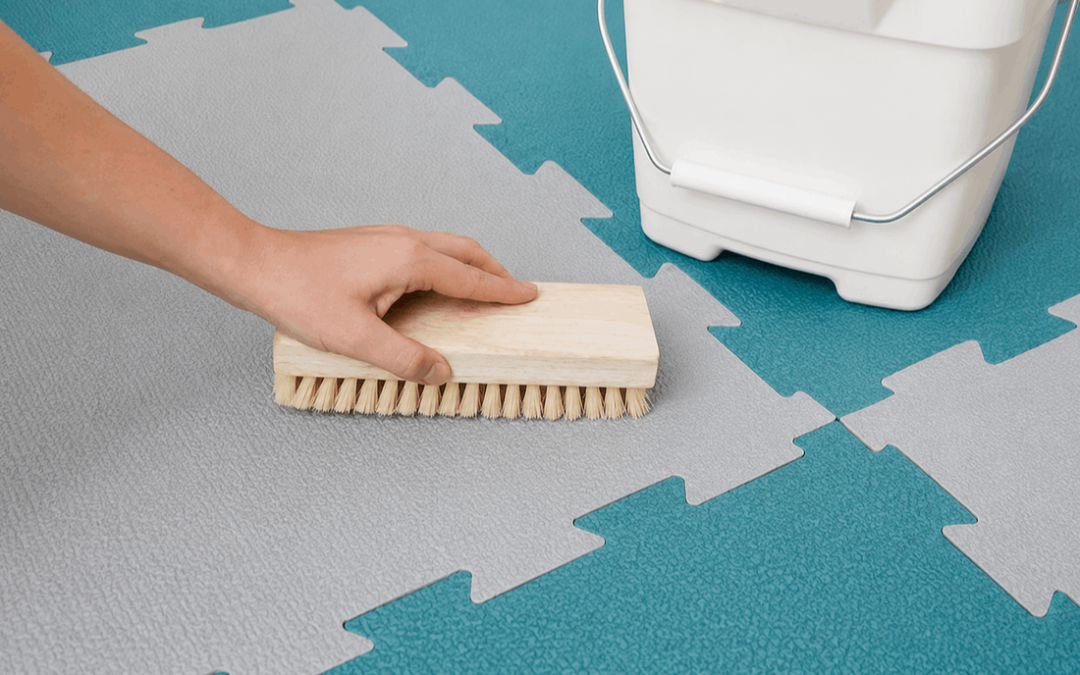
Learning how to clean and maintain EVA foam mats helps protect their appearance, preserve the interlocking edges and keep playrooms, classrooms and light exercise areas easier to manage. EVA flooring is lightweight and removable, but dirt, spills and moisture can collect on the surface or enter the puzzle joints when cleaning is delayed or too much water is used. The best routine combines regular sweeping, careful spot cleaning and periodic lifting of selected tiles to inspect the permanent floor below. For suitable soft indoor flooring options, browse our EVA Foam Mats collection.
What Is the Best Way to Clean EVA Foam Mats?
Begin by sweeping or vacuuming away loose dirt. Wipe the surface with a soft cloth or controlled damp mop using a mild cleaner approved for the mat. Avoid flooding the floor because liquid can pass through the interlocking joints. Treat spills promptly, rinse away cleaning residue where necessary and allow both the foam and the permanent floor to dry completely before reconnecting lifted tiles.
Remove loose dirt
Sweep or vacuum dust, crumbs, sand and other particles before adding moisture to the floor.
Use controlled moisture
Clean with a damp cloth or mop rather than pouring water across the interlocking surface.
Dry and inspect
Allow the mats to dry fully and check the puzzle joints, edges and substrate before the area is reused.
Why EVA Foam Mat Maintenance Matters
EVA foam mats are commonly installed in children’s playrooms, crèches, classrooms, stretching zones and home activity areas. These rooms often experience close contact with the floor, making regular care important for both appearance and practical day-to-day use.
Dust, sand and crumbs can settle inside the textured surface or collect along the puzzle joints. When left in place, these particles may become harder to remove and can be transferred across the room by toys, feet and exercise accessories.
Moisture creates a different concern. The foam surface may resist minor spills, but interlocking connections are not necessarily watertight. Water can move between the tiles and remain trapped against ceramic tiles, laminate, concrete or another permanent surface.
Regular cleaning also provides an opportunity to inspect the condition of the mats. Split puzzle teeth, loose borders, lifting corners and compressed sections can be identified before they become larger problems.
A consistent routine therefore helps keep the flooring presentable while reducing the need for aggressive cleaning later. Gentle, regular care is normally more suitable than waiting for heavy dirt to build up.
Cleaning Supplies You May Need
You do not need complicated equipment to maintain most EVA flooring. The safest starting point is a small selection of gentle tools that will not cut, scratch or soak the foam.
Useful cleaning items
- A soft-bristled broom.
- A vacuum with a suitable hard-floor setting.
- Microfibre cloths.
- A soft sponge without an abrasive side.
- A controlled damp mop.
- Clean lukewarm water.
- A mild cleaner approved for the mat.
- Dry towels for absorbing spills.
- A bucket used with minimal water.
- Matching spare tiles for replacement.
Items to avoid unless approved
- Hard scrubbing brushes.
- Steel wool and abrasive pads.
- Strong solvents.
- Undiluted bleach.
- Harsh degreasers.
- Highly abrasive powders.
- Steam cleaners.
- Pressure washers.
- Very hot water.
- Excessive fragrance or polish.
Always check the supplier’s care instructions
EVA products can differ in surface finish, pigments, density and construction. Test any unfamiliar cleaner on a small hidden area before applying it across the complete floor.
How to Clean and Maintain EVA Foam Mats Step by Step
The following routine is suitable for general indoor maintenance. Adjust the frequency according to the number of users, activities, shoes, spills and level of daily traffic.
Clear the activity area
Remove toys, exercise accessories, storage boxes and lightweight furniture. Clearing the floor makes it easier to reach the joints and identify stains or damaged sections.
Inspect the complete surface
Look for loose border strips, separated joints, cuts, compressed sections and visible moisture. Deal with damaged tiles before beginning the main cleaning process.
Sweep or vacuum loose dirt
Remove dust, hair, crumbs, sand and small particles. Vacuum carefully along puzzle joints and outside edges without using a setting that pulls strongly at the foam.
Prepare a mild cleaning solution
Use a product approved for the mat and follow its dilution instructions. Do not assume that a stronger mixture will clean better, because concentrated products may leave residue or affect the surface.
Clean one manageable section
Wipe the mat with a soft cloth, sponge or controlled damp mop. Work across a small area at a time so that moisture does not sit on the floor unnecessarily.
Pay attention to textured areas
Use gentle repeated wiping to remove dirt from the surface pattern. Avoid hard scrubbing that may polish, scratch or damage the texture.
Remove cleaning residue
Where the product instructions require rinsing, wipe the section again with a clean damp cloth. Residue may make the surface feel sticky and attract more dirt.
Dry the surface
Use clean towels to remove visible moisture, then allow the area to air dry. Keep children, pets and exercise users away until the floor is completely dry.
Reconnect and inspect the joints
Press any separated puzzle edges back into position. Confirm that borders and corners lie flat before returning toys or accessories to the room.
How Often Should EVA Mats Be Cleaned?
There is no single cleaning schedule suitable for every room. A quiet home stretching area may require less frequent attention than a busy crèche or children’s playroom.
| Cleaning Task | Suggested Frequency | Purpose |
|---|---|---|
| Remove visible dirt and crumbs | After use or whenever noticed | Prevents particles from spreading or entering joints |
| Sweep or vacuum | Several times per week in busy rooms | Controls loose dust, hair and sand |
| Spot-clean spills | Immediately | Reduces staining and moisture entering the joints |
| Damp-clean the surface | Weekly or according to room use | Removes ordinary marks and surface residue |
| Inspect puzzle joints | During each cleaning session | Identifies loose, split or raised sections |
| Lift selected tiles | Periodically and after larger spills | Checks for trapped moisture and dirt below |
| Deep-clean the area | When required by use and condition | Provides a more complete inspection of mats and substrate |
Busy childcare and shared activity rooms should follow their own documented cleaning procedures. Increase the frequency when food, outdoor shoes, messy play or several daily users are involved.
How to Clean Spills on EVA Foam Mats
Fast action is the easiest way to prevent a minor spill from becoming a larger cleaning task. Begin by stopping people from walking through the affected section.
Absorb the liquid
Use a clean dry towel to blot the spill. Avoid spreading it across additional tiles or pressing excessive liquid into the puzzle joints.
Disconnect affected tiles if necessary
If liquid has reached the joints, lift the surrounding pieces carefully. Inspect both the underside of the foam and the permanent floor.
Clean the visible mark
Use a mild approved cleaner and a soft cloth. Work gently from the outside of the mark toward the centre instead of spreading it outward.
Dry both surfaces
Do not reconnect the flooring while the mat or substrate remains damp. Stand lifted tiles in a supported position and allow airflow around them.
Check for staining or odour
Repeat gentle cleaning where necessary. If an odour remains beneath the floor, continue drying and inspect whether moisture has travelled farther than expected.
Spill-control tip: Keep dry towels and a mild approved cleaner near busy playrooms and classrooms so spills can be handled before they reach several puzzle joints.
Cleaning Food, Drinks and Sticky Marks
Food and sweet drinks can leave a sticky film that attracts dust. Remove any solid pieces first, then wipe the affected tile with a soft damp cloth and mild cleaning solution.
Do not scrape dried food with a sharp tool. Allow a damp cloth to sit briefly on the mark so it can soften, then wipe gently.
After the mark is removed, use a second clean damp cloth where necessary to remove residue. Dry the section fully before it is used again.
In children’s areas, it may be practical to keep eating sections separate from the foam play zone. This reduces crumbs and liquid reaching the interlocking connections.
Cleaning Paint, Crayons and Craft Marks
Craft activities can leave paint, glue, crayons and marker stains on foam flooring. The correct response depends on the type of material involved and the surface finish of the mat.
Remove wet craft material promptly using a soft cloth. Avoid rubbing the mark across a larger area.
For dried marks, use only a cleaning product approved by the flooring supplier. Strong solvents used to remove paint or marker may also remove colour or damage the EVA surface.
Permanent ink and deeply absorbed pigments may not be removable without affecting the mat. Replacing one damaged interlocking tile may be safer than using aggressive chemicals across the floor.
Use protective craft sheets or washable trays when messy activities take place in the room. Prevention is normally easier than removing dried paint from a textured surface.
How to Clean Kids’ Foam Mats
Children’s playrooms require a routine that considers crumbs, toys, floor-level contact and frequent small spills. Remove loose dirt regularly and clean visible marks as soon as possible.
Separate routine cleaning from sanitising or disinfecting. Cleaning removes dirt and residue, while additional processes may be required in specific childcare situations or when someone is ill.
Follow the facility’s hygiene procedures, the cleaner’s label and the mat supplier’s care instructions. A product suitable for a hard countertop may not automatically be suitable for EVA foam.
The external CDC guidance for cleaning early-care and education settings provides general information about cleaning surfaces before sanitising or disinfecting and using cleaning products according to their instructions.
After cleaning, check that no liquid, loose border pieces or cleaning residue remain. Children should return only when the floor is dry and every puzzle joint lies flat.
Can EVA Foam Mats Be Disinfected?
Disinfection may be considered in particular situations, but it should not automatically form part of every routine clean. Ordinary dirt and spills should first be removed through cleaning.
Before applying a disinfectant, confirm that the product is suitable for EVA foam and for the room in which the mats are installed. Follow the product label, including dilution, contact time, ventilation and rinsing instructions.
Do not mix cleaning products. Combining different chemicals can damage the mat and may create unsafe fumes.
Avoid assuming that undiluted bleach is suitable. Strong solutions may affect colour, surface finish or puzzle edges. Use it only when the flooring supplier and the product label confirm compatibility.
Where frequent disinfecting is required, test the approved method on a spare tile first. This allows you to check whether the colour, texture or firmness changes after drying.
How to Deep-Clean Interlocking EVA Mats
A deeper clean is useful when dirt has collected beneath the tiles, a large spill has entered several joints or the room is being reorganised.
Photograph the existing pattern
Take a simple photograph before lifting the floor. This helps you reinstall colours and border pieces in the same arrangement.
Label irregular sections
If tiles have been cut around pillars or cupboards, mark their positions discreetly so they return to the correct place.
Lift the tiles carefully
Disconnect one row at a time rather than pulling the floor apart roughly. Avoid bending the puzzle teeth excessively.
Clean both sides
Remove loose dirt from the top and underside. Use controlled moisture and a mild approved cleaner where deeper wiping is necessary.
Clean the permanent floor
Sweep and clean the substrate using a method appropriate for ceramic tiles, laminate, concrete or the existing surface.
Allow full drying
Do not reinstall the mats until the foam, puzzle edges and permanent floor are completely dry.
Reinstall in an organised direction
Use the photograph and any labels to rebuild the layout. Inspect each connection as the floor is reassembled.
How to Prevent Mould and Odours Beneath Foam Mats
EVA foam itself may resist small surface spills, but moisture trapped beneath the floor can create persistent odours or affect the substrate.
Do not install mats over unexplained dampness. If the room has recurring moisture, identify the source before covering the floor.
Avoid flooding the mats during routine cleaning. Use only enough moisture to wipe the surface effectively.
Lift affected tiles immediately after a large spill. Drying only the top surface is not enough when liquid has passed through the joints.
Rooms should have appropriate ventilation. In humid spaces, inspect beneath selected tiles more frequently.
Do not place damp mats back into storage or stack them tightly while wet. Allow airflow around every piece until both sides are dry.
Do not cover ongoing moisture problems
If dampness returns after cleaning, stop reinstalling the mats until the underlying issue has been identified and corrected.
Maintaining Puzzle Joints and Border Pieces
The interlocking design makes EVA tiles easy to install and rearrange, but the puzzle edges require regular inspection.
Reconnect joints that begin to separate. Check whether dirt, damaged teeth or incorrect alignment are preventing the pieces from closing properly.
Do not force incompatible tiles together. Puzzle patterns can differ between brands and product ranges even when the listed dimensions appear similar.
Straight border pieces should remain securely connected. Loose optional pieces require particular attention in rooms used by young children.
Replace a tile when its puzzle teeth are permanently stretched, split or missing. A damaged connection may continue separating even after repeated adjustment.
How to Store EVA Foam Mats
Clean and dry every tile before storage. Dirt or moisture trapped between stacked pieces may leave marks or odours.
Store the mats flat where possible. Heavy objects placed on top may cause compression or distortion.
Keep the tiles away from direct heat, sharp tools and prolonged sunlight. Avoid folding foam tiles that are designed to remain flat.
Stack matching pieces together and keep border strips in a separate labelled group. This makes later installation easier.
If the mats are stored for an extended period, inspect them before reuse. Check for damage, odour, warping and changes to the puzzle connections.
Cleaning Mistakes That Can Damage EVA Mats
Using too much water
Excess liquid can enter the joints and remain trapped beneath the flooring. Use controlled moisture rather than soaking the mats.
Scrubbing with abrasive tools
Hard brushes and rough pads may scratch or smooth the textured surface. Use soft tools and repeated gentle wiping.
Applying strong solvents
Solvents may affect the colour, finish or structure of the foam. Use only products confirmed as compatible.
Using very hot water or steam
Excessive heat may distort some foam products. Follow the supplier’s temperature and cleaning instructions.
Reinstalling damp tiles
Moisture trapped below the mat can lead to odours or damage to the permanent floor.
Ignoring cleaning residue
Sticky residue attracts new dirt and may change how the surface feels. Wipe away residue according to the cleaner’s instructions.
Mixing cleaning products
Different chemicals should not be combined. Use one suitable product according to its label.
Leaving damaged tiles in use
Split edges and loose pieces should be replaced rather than repeatedly pushed back into position.
EVA Foam Mat Maintenance Checklist
- Remove visible crumbs and spills promptly.
- Sweep or vacuum loose dirt regularly.
- Use a soft cloth, sponge or controlled damp mop.
- Choose a mild cleaner approved for EVA foam.
- Test unfamiliar products on a hidden section.
- Avoid flooding the puzzle joints.
- Lift tiles when liquid reaches the substrate.
- Dry the foam and permanent floor completely.
- Inspect joints and border strips during cleaning.
- Replace split, crumbling or damaged pieces.
- Keep strong solvents and abrasive tools away.
- Do not use unapproved steam-cleaning equipment.
- Follow hygiene procedures for shared childcare areas.
- Store clean mats flat and completely dry.
- Keep several matching spare tiles for replacement.
Frequently Asked Questions
What is the easiest way to clean EVA foam mats?
Sweep or vacuum loose dirt, then wipe the surface with a soft damp cloth or mop and a mild cleaner approved for the mat.
Can EVA mats be washed with water?
They can usually be damp-cleaned, but they should not be flooded. Water may pass through the puzzle joints and reach the floor underneath.
Can I use dishwashing liquid on foam mats?
A small diluted amount may suit some products, but always confirm the supplier’s cleaning instructions and test it on a hidden area first.
Can bleach be used on EVA foam?
Do not use bleach unless the mat supplier and the cleaning-product label confirm that the method is suitable. Strong solutions may affect the surface or colour.
Can I steam-clean EVA foam tiles?
Steam cleaning is generally not recommended unless specifically approved because heat and moisture may affect the foam or enter the joints.
How often should children’s foam mats be cleaned?
Remove spills immediately and clean according to the amount of daily use. Busy shared playrooms normally require more frequent attention than quiet home areas.
How do I remove liquid beneath interlocking mats?
Disconnect the affected tiles, absorb the liquid and allow both the mats and permanent floor to dry completely before reinstalling them.
Can EVA mats be cleaned outside?
Indoor mats should not be left in direct sunlight or soaked outdoors. Follow the supplier’s instructions and dry them in a suitable ventilated area.
How do I remove a sticky feeling after cleaning?
Wipe the surface again with a clean damp cloth to remove cleaner residue, then dry it fully before use.
Can one stained EVA tile be replaced?
Yes. Interlocking systems often allow one tile to be removed and replaced when a matching piece with the same dimensions and joint pattern is available.
Why does the floor smell beneath my foam mats?
Trapped moisture, dirt or residue may cause odours. Lift the tiles, clean both surfaces and allow complete drying before reinstalling them.
Should EVA mats be disinfected every day?
Not necessarily. Routine cleaning may be sufficient in many situations. Follow the room’s hygiene policy and use disinfectants only when appropriate and compatible with the flooring.
Final Advice on How to Clean and Maintain EVA Foam Mats
Understanding how to clean and maintain EVA foam mats begins with a simple routine: remove loose dirt, treat spills promptly, use controlled moisture and allow the surface to dry completely.
Regular sweeping or vacuuming prevents dust, sand and crumbs from building up inside the textured finish and puzzle connections. A mild approved cleaner and soft cloth are normally more suitable than aggressive chemicals or hard scrubbing tools.
Avoid flooding the floor. Although the foam surface may resist small spills, the interlocking joints are not necessarily watertight. Liquid can reach the permanent floor and remain hidden beneath the mats.
Lift affected tiles whenever moisture enters the joints. Clean and dry both the EVA flooring and the substrate before reconnecting the pieces.
Children’s rooms, crèches and classrooms may require more frequent cleaning than quiet home exercise areas. Follow the facility’s hygiene procedures while also checking that every cleaning or disinfecting product is suitable for the foam.
Use each cleaning session as an inspection opportunity. Check for split puzzle teeth, lifting corners, loose borders, compression and permanent stains. Replace damaged individual tiles rather than continuing to use an unstable section.
For deeper maintenance, photograph the layout, disconnect the tiles in an organised order and clean the permanent floor below. Reinstall the mats only after every surface is fully dry.
With gentle products, controlled water and regular inspections, EVA foam flooring can remain presentable and practical across playrooms, classrooms, stretching areas and other dry indoor activity spaces.
Compare Easy-to-Maintain EVA Foam Mats
Choose modular flooring suited to dry indoor play, learning, stretching and light activity areas. Review available EVA foam mat options, sizes and applications before planning your space.
View EVA Foam Mats