
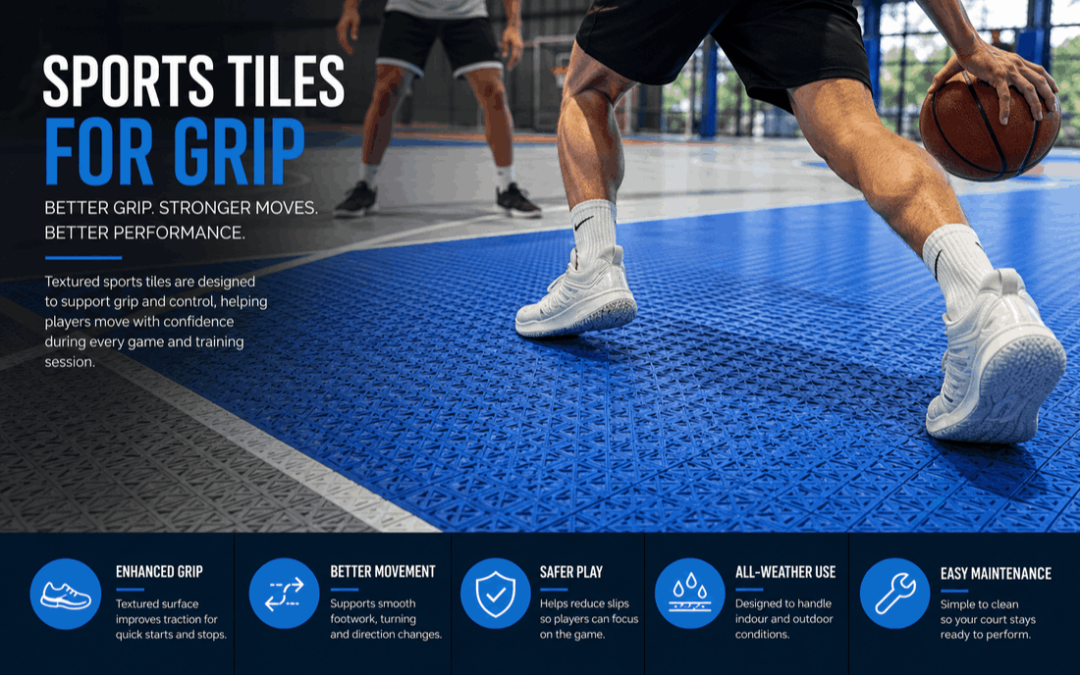
Sports tiles for grip can support controlled starts, stops, turns and changes of direction during active court use. However, grip is not created by the tile surface alone. Footwear, cleaning, dust, moisture, court maintenance and the type of movement all influence how secure the floor feels underfoot. For suitable modular options, explore our textured sports flooring for active courts.
Players rarely move in only one direction. Court activities often involve acceleration, sudden stopping, side-to-side movement, turning, landing and repeated changes of pace. The floor must support these actions while remaining practical to clean and inspect.
This guide explains how sports tiles for grip influence player movement, what affects surface traction and why regular maintenance is essential for keeping indoor and outdoor courts ready for use.
What Does Grip Mean on a Sports Court?
Grip refers to the contact between footwear and the playing surface during movement. A suitable level of traction can help players push away from the floor, slow down and change direction with greater control.
However, more grip is not always better. A surface that creates excessive resistance may interfere with natural turning or place unnecessary demand on footwear and movement. The goal is controlled traction that suits the intended activity.
Grip can support:
- Controlled acceleration
- Stable deceleration
- Side-to-side footwork
- Turning and direction changes
- Balanced landing
- Confident court movement
- Repeated training drills
Grip can be reduced by:
- Loose dust
- Water or moisture
- Mud and soil
- Leaves and debris
- Cleaning-product residue
- Worn surface sections
- Unsuitable footwear
How Sports Tiles for Grip Support Movement
Sports tiles for grip often use a textured upper surface rather than a completely smooth finish. This texture can increase contact points between the tile and footwear during normal court activity.
The pattern, material and condition of the tile all influence the way the surface feels. The flooring should also remain stable over the base so that the tiles do not shift during movement.
Foot contacts the textured surface
The footwear sole meets the tile pattern during running, turning or stopping.
The tile supports controlled traction
The surface texture helps support movement when it is clean, dry and suitable for the activity.
The player changes pace or direction
Controlled contact can support quick footwork, turning and repeated movement drills.
Grip Is a Complete Court Condition
Tile texture matters, but the final court condition also depends on footwear, cleaning, moisture, dust, installation quality and ongoing maintenance.
Surface Texture and Footwear Contact
A textured tile surface creates small raised sections, patterns or openings that interact with the sole of the shoe. This can help the footwear maintain contact while the player moves across the floor.
Different footwear soles may behave differently on the same court. Shoes intended for indoor sport may not respond in the same way as general casual footwear, outdoor trainers or shoes with worn soles.
Tile texture
The pattern should suit the intended environment and activity without becoming difficult to maintain.
Footwear condition
Worn or dirty shoe soles can reduce effective contact with the sports surface.
Court cleanliness
Dust, moisture and debris can form a layer between the footwear and tile texture.
Grip During Quick Acceleration
Players often push against the floor when beginning a sprint or moving toward a ball. The surface should support this movement without feeling unstable.
During acceleration, the footwear needs to maintain contact while force is applied through the foot. Loose dirt, moisture or moving tiles can affect this contact.
Courts used for repeated speed drills should be inspected frequently, particularly in starting zones where the same movement happens many times.
Grip During Stopping and Deceleration
Stopping places different demands on the floor from acceleration. Players may reduce speed quickly, plant a foot and prepare to change direction.
The court should provide suitable traction while allowing natural movement. Surface contamination can make stopping less controlled, particularly where water, dust or cleaning residue is present.
Inspect common stopping areas for:
- Polished or worn tile sections
- Loose modular joints
- Dust build-up
- Moisture carried onto the court
- Shoe marks and cleaning residue
- Changes in surface level
- Damaged or cracked tiles
Side-to-Side Movement and Direction Changes
Basketball-style drills, netball movement, tennis practice and multi-sport activities may involve repeated lateral movement. Players often plant one foot before moving in a new direction.
A stable, clean and suitably textured surface can support these movements. However, the floor should not be described as completely non-slip because any surface can become less secure when contaminated or incorrectly maintained.
Movement that needs control
- Side steps
- Quick turns
- Defensive movement
- Shuttle drills
- Short sprints
- Controlled landings
Court factors to check
- Surface texture
- Tile stability
- Footwear suitability
- Dust levels
- Moisture exposure
- Cleaning frequency
Why Non-Slip Does Not Mean Slip-Proof
The phrase non-slip sports flooring is often used to describe textured surfaces designed to support traction. However, no court should be treated as completely slip-proof under every possible condition.
Water, mud, oil, cleaning residue, loose soil and unsuitable footwear can all change how the floor performs. Facilities should therefore combine suitable flooring with cleaning, inspection and good court management.
Important: A textured sports tile can support grip, but maintenance and court conditions still determine how the surface performs during use.
Indoor Sports Tiles and Grip
Indoor courts are protected from direct rainfall, but they can still develop grip problems. Dust, shoe marks, moisture carried through entrances and cleaning residue may affect the surface.
Large sports halls may also receive heavy daily traffic. High-use sections should be inspected more often than quiet areas around the perimeter.
Supports grip when:
The floor is clean, dry, stable and used with suitable sports footwear.
Grip may reduce when:
Dust, moisture, cleaning residue or worn shoe soles affect contact with the surface.
Outdoor Sports Tiles and Grip
Outdoor courts experience additional conditions such as rain, leaves, mud, dust and changing temperatures. Open-grid designs can help water move through the upper surface, but drainage alone does not remove every grip risk.
The court should be inspected after rain and cleared of debris before use. Low areas, blocked drainage routes and muddy entrances should be addressed as part of routine maintenance.
For a clearer comparison between indoor and outdoor court requirements, read our guide to how court conditions affect flooring performance.
How Dust Affects Court Grip
Fine dust can create a loose layer between footwear and the tile surface. This may be more noticeable on indoor courts with high foot traffic or outdoor courts near unpaved ground.
Sweeping should remove dust rather than spreading it across the playing area. Entrances should also be managed so that users do not continually carry loose material onto the court.
Common dust sources include:
- Unpaved entrance paths
- Nearby construction
- Open doors and windows
- Dry outdoor conditions
- Dusty footwear
- Infrequent sweeping
Helpful management steps include:
- Clean entrance areas
- Use suitable entrance matting
- Sweep before busy sessions
- Inspect high-traffic zones
- Keep storage areas clean
- Follow supplier instructions
How Water and Moisture Affect Grip
Water can reduce the contact between footwear and a court surface. Outdoor courts may become wet after rain, while indoor courts may receive moisture from entrances, spills or cleaning.
Wet areas should be managed before organised play continues. Outdoor facilities should also check whether water is draining correctly rather than remaining in low sections.
Check wet courts for:
- Standing water
- Blocked drainage openings
- Water near court entrances
- Moisture carried indoors
- Muddy sections
- Damaged perimeter drainage
- Repeated wet patches
Cleaning Products and Surface Residue
Using too much cleaning product or failing to rinse correctly may leave residue on the sports floor. This can change the way footwear contacts the surface.
Cleaning methods should follow the flooring supplier’s instructions. Facilities should avoid using unsuitable polishes, oils or products that create a coating over the tile texture.
Always test unfamiliar cleaning products in a small area before applying them across the full court.
How Wear Affects Player Movement
Busy courts do not always wear evenly. Entrances, court centres, goal areas, key lines and regular drill zones may receive more traffic than other sections.
Modular flooring can make it easier to inspect selected areas and replace damaged tiles where appropriate. Early replacement may prevent a small damaged section from affecting a larger part of the court.
Inspect
Check busy movement areas, joints and court entrances regularly.
Clean
Remove contaminants before they become compacted into textured surfaces.
Replace
Address damaged modular sections before they interfere with normal movement.
Choosing Sports Tiles for Grip
When selecting sports tiles for grip, begin with the environment and planned activity. An indoor multi-purpose hall may have different needs from an exposed outdoor basketball or netball court.
The flooring supplier should confirm whether the tile is suitable for the intended location, sport, traffic level and base surface.
Ask these questions before choosing tiles:
- Will the court be indoors or outdoors?
- Which sports will be played most often?
- What footwear will users wear?
- Will the court be exposed to rain?
- How frequently will the floor be cleaned?
- Is the existing base firm and level?
- Can damaged sections be replaced?
Base Stability and Tile Movement
Surface grip can be undermined if the tiles or supporting base move unexpectedly. The base should be firm, stable and suitably prepared before installation.
Large cracks, loose concrete, major low spots and uneven transitions should be assessed. Modular joints should also be checked during routine inspections.
A textured surface cannot provide consistent movement support when the flooring beneath the player is unstable.
Sports Tiles for Schools and Training Centres
Schools and training centres may have many users moving through the same court each day. Physical education, coaching sessions, team practice and general recreation can create concentrated wear.
Cleaning and inspection responsibilities should therefore be clearly assigned. Facilities should check the court before organised activities rather than waiting for users to report a problem.
Daily checks
- Loose debris
- Wet patches
- Damaged tiles
- Movement at joints
- Dirty entrances
- Cleaning residue
Scheduled checks
- High-traffic wear
- Base movement
- Drainage performance
- Court-line condition
- Tile replacement needs
- Cleaning procedure review
Sports Tiles for Clubs and Community Courts
Club and community courts may be used for training, public recreation and organised events. The flooring must support varied movement while remaining manageable for staff and volunteers.
Busy facilities should pay particular attention to entrances, perimeter areas and locations where users gather between sessions. These sections may collect more dirt and moisture than the main playing zone.
Maintaining Grip Through Regular Cleaning
Regular cleaning helps preserve the texture of the sports surface and removes materials that interfere with footwear contact.
The correct routine depends on whether the court is indoors or outdoors, how often it is used and what type of dirt reaches the floor.
Basic grip-maintenance routine:
- Sweep loose dust and debris.
- Remove spills promptly.
- Keep entrances clean and dry.
- Clear outdoor drainage openings.
- Use suitable cleaning products.
- Inspect worn court sections.
- Replace damaged modular tiles when needed.
For broader guidance about managing wet or contaminated surfaces, refer to the Health and Safety Executive guidance on preventing slips and trips.
Common Mistakes That Reduce Court Grip
One common mistake is assuming that textured tiles require no maintenance. Dirt and moisture can still cover the texture and affect footwear contact.
Another mistake is using the wrong cleaning product. A floor polish or oily cleaner may leave residue that changes the way the court performs.
Avoid these flooring mistakes:
- Choosing tiles only by colour
- Ignoring the intended sport
- Installing over an unstable base
- Using indoor tiles outdoors
- Ignoring damaged joints
- Allowing high-use areas to wear excessively
Avoid these maintenance mistakes:
- Leaving dust on the court
- Using unsuitable cleaners
- Ignoring water after rain
- Allowing mud to dry in tile openings
- Failing to inspect entrances
- Assuming the floor is slip-proof
Final Advice on Sports Tiles for Grip
Sports tiles for grip can support controlled footwork, turning, acceleration and stopping when the flooring is correctly chosen, installed and maintained.
Tile texture is important, but it is only one part of court performance. Footwear, dust, moisture, cleaning residue, surface wear and base stability all influence player movement.
Choose the surface according to the court environment and intended activity. Then support it with regular cleaning, inspection and timely replacement of damaged modular sections.
Contact Us About Sports Tiles for Grip
PVC Floor Tile supplies modular sports flooring for schools, clubs, training centres, indoor halls and outdoor courts across South Africa. Send our team the court dimensions, planned sports, existing base condition and whether the area is indoors or outdoors so we can help you identify a suitable option.
Contact Us