
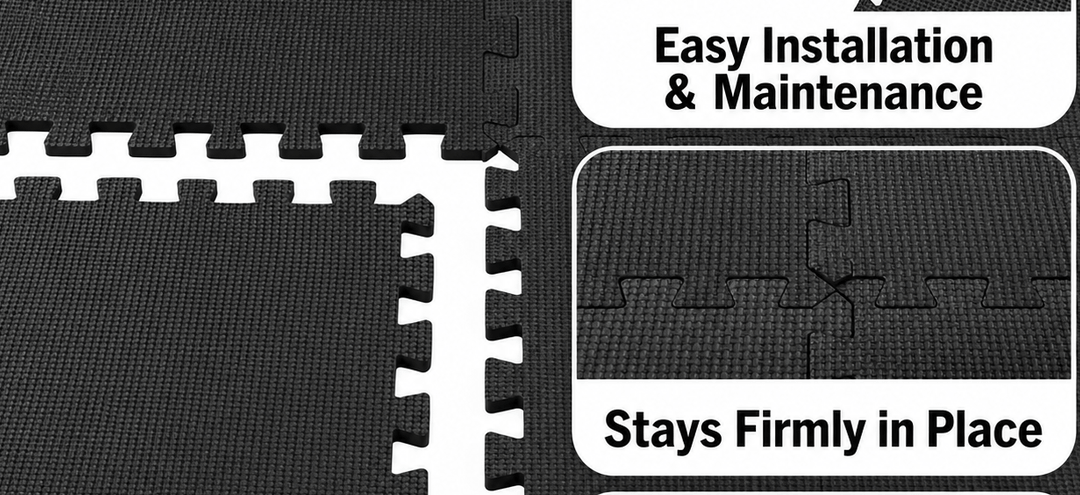
EVA foam mats for community centres can create softer, more comfortable zones for supervised children’s programmes, reading groups, floor activities, stretching sessions and light indoor movement. Their modular puzzle design allows organisers to cover a selected part of a multipurpose hall without permanently replacing the existing floor. However, not every area in a community facility has the same flooring requirements. Busy entrances, kitchens, heavy-equipment zones and formal sports activities may require stronger or more specialised surfaces. For soft modular options intended for dry indoor play and light activity spaces, explore our EVA Foam Mats collection.
Are EVA Foam Mats Suitable for Community Centres?
Yes, EVA foam mats can suit selected dry indoor areas used for supervised children’s activities, reading groups, light exercise, stretching, floor-based learning and temporary community programmes. Their main strengths are comfort, lightweight handling and modular installation. They are generally not the best choice for busy entrances, permanent seating areas, heavy equipment, dropped weights, workshops, wet rooms or high-traffic passages.
Plan by activity
Match each floor section to the people, furniture, movement and equipment normally used in that part of the centre.
Create flexible zones
Interlocking tiles can define a temporary play, learning or movement section inside a larger multipurpose room.
Plan maintenance
Selected tiles can be lifted for cleaning, inspection or replacement when the underlying floor needs attention.
Why Community Centres Need Flexible Flooring
Community centres often support a wide range of programmes from the same building. One hall may be used for an early-learning group in the morning, a senior stretching class in the afternoon and a public meeting in the evening.
This makes floor selection more complicated than choosing one material for one purpose. A floor that feels comfortable for sitting and stretching may be too soft beneath rows of heavy chairs. A firm surface suited to events may feel uncomfortable during floor-based children’s programmes.
Modular flooring helps centres respond to these changing activities. Rather than replacing the full permanent floor, organisers can create selected zones that are assembled for suitable programmes and stored when another event requires the open hall.
EVA foam is particularly useful where softness and lightweight handling are the priorities. It can create a defined section over ceramic tiles, concrete, laminate or another firm indoor surface.
The centre should still assess the whole room. Doors, emergency routes, heavy furniture, equipment, moisture, cleaning and user needs must be considered before any temporary floor is installed.
Understanding EVA Foam Activity Flooring
EVA stands for ethylene-vinyl acetate. For indoor flooring, it is commonly formed into lightweight foam tiles with puzzle-shaped edges.
The puzzle connections allow several pieces to form a larger continuous activity area. Compatible border strips may be added around exposed outside edges where they are supplied.
The foam provides a cushioned surface that can feel more comfortable than a bare hard floor during sitting, kneeling, stretching and controlled movement.
EVA is generally softer and lighter than dense rubber gym flooring or rigid PVC interlocking tiles. This makes it easier to move, but it also means it can compress beneath concentrated loads.
Community managers should compare thickness, firmness, tile dimensions, surface texture, intended use and cleaning instructions. Similar-looking products may perform differently.
Ordinary EVA foam remains comfort-focused flooring. It should not automatically be presented as industrial flooring, professional sports surfacing, fire-rated event flooring or certified impact protection.
Best Uses for EVA Foam Mats in Community Centres
Children’s programmes
Create softer sections for supervised reading, building toys, puzzles, floor learning and light indoor play.
Wellness activities
Use cushioned zones for stretching, mobility exercises, gentle movement and controlled floor-based sessions.
Temporary group areas
Define workshop, hobby or community-learning sections without making a permanent change to the hall.
Other possible applications include parent-and-child groups, supervised after-school activities, quiet corners, holiday programmes, light rehabilitation classes and reading clubs.
The planned activity must remain within the product’s limits. Fast sports, loaded fitness equipment and activities involving sharp objects require flooring selected for those conditions.
Where EVA Foam Should Not Be Used
EVA may suit
- Supervised children’s play sections.
- Reading and storytelling groups.
- Floor-based educational activities.
- Stretching and gentle mobility classes.
- Light bodyweight movement.
- Parent-and-child sessions.
- Quiet sensory areas.
- Temporary indoor programme zones.
- Community hobby activities without sharp tools.
- Dry multipurpose rooms with controlled use.
Choose another surface for
- Busy public entrances.
- High-traffic passages and stairways.
- Kitchens and food-preparation areas.
- Bathrooms and continuously wet rooms.
- Workshops involving sharp tools.
- Heavy fitness machines.
- Free-weight and dropped-weight zones.
- Formal indoor sports courts.
- Permanent rows of heavy seating.
- Raised play equipment requiring tested surfacing.
One hall may require more than one flooring material
A mixed-flooring plan is often more practical than expecting EVA to perform every role. Soft foam can cover the light activity zone, while firmer flooring remains in entrances, furniture areas and busy walking routes.
Benefits of EVA Foam Mats for Community Centres
Comfort for floor-based programmes
Reading groups, children’s activities and gentle stretching often require participants to sit, kneel or move close to the floor. EVA creates a softer layer over hard indoor surfaces.
Modular room planning
The interlocking format allows the centre to cover only the area required for a particular programme. This can preserve open space for chairs, tables and normal walking routes.
Lightweight handling
EVA is generally easier to lift and carry than dense rubber flooring. This can benefit facilities that frequently change room layouts.
Individual tile replacement
A damaged or permanently stained piece can often be replaced without removing the full floor, provided a compatible tile is available.
Access to the permanent floor
Selected sections can be lifted when a spill reaches the puzzle joints or when staff need to inspect and clean the substrate.
Clear activity-zone definition
A different colour or texture can help identify where a supervised programme takes place without installing a permanent wall or barrier.
Flexible storage
When carefully disconnected and stored flat, the mats can be kept for the next suitable activity.
Important Limitations to Understand
Heavy furniture may compress the foam
Tables, storage cupboards, stacked chairs and equipment with narrow feet may leave permanent impressions. Keep heavy permanent items on the original floor where possible.
Puzzle joints are not automatically watertight
Liquid can pass through the connections. Large spills require affected tiles to be lifted so both surfaces can dry.
Foam can be cut or punctured
Sharp furniture edges, damaged chair legs, craft blades and tools may damage the surface.
It is not suitable for every exercise session
Gentle stretching may suit EVA, but heavy machines, fast movement and loaded strength training normally require denser flooring.
Loose transitions need attention
The edge between EVA and the surrounding floor should remain visible, stable and away from uncontrolled walking routes.
Indoor products should remain indoors
Mats intended for dry interior rooms should not be exposed continuously to rain, strong sunlight or standing water.
Planning Different Zones Inside a Multipurpose Hall
A good layout separates activities according to their flooring needs instead of covering the whole hall automatically.
| Community Centre Zone | Typical Activity | Recommended Flooring Approach | Important Consideration |
|---|---|---|---|
| Children’s corner | Reading, puzzles and supervised floor play | Selected EVA foam section | Inspect loose borders and joints regularly |
| Gentle movement area | Stretching and controlled mobility sessions | EVA may provide suitable cushioning | Avoid heavy equipment and fast directional movement |
| Meeting area | Tables and rows of chairs | Firm permanent flooring | Chair legs may compress soft foam |
| Main entrance | Outdoor dirt and frequent foot traffic | Purpose-made entrance flooring | Moisture and grit require stronger matting |
| Fitness machine zone | Exercise bikes, treadmills and equipment | Dense rubber or machine flooring | Equipment weight can compress EVA |
| Kitchen or food area | Food preparation and cleaning | Suitable firm washable flooring | Spills and hygiene procedures must be considered |
| Storage area | Stacked furniture and programme equipment | Firm load-supporting floor | Concentrated loads may damage foam |
| Formal sports zone | Fast running and directional movement | Sport-specific flooring | Ordinary EVA is not a professional court system |
EVA foam mats for community centres are most effective when they are treated as one component of the complete flooring plan rather than a universal solution.
Choosing the Correct Mat Thickness
Thickness affects cushioning and the finished floor height, but it does not determine suitability on its own.
Foam firmness and density influence how the tile responds beneath knees, feet, furniture and programme equipment. Two tiles of the same thickness may feel noticeably different.
For many children’s and light activity zones, a 12mm EVA mat can provide a practical balance between comfort and manageable height. The exact product should still be selected according to the programme and expected use.
Check the following before ordering:
- The listed mat thickness.
- The length and width of each tile.
- The foam firmness or density information.
- The intended indoor applications.
- The number of pieces in each pack.
- The total square-metre coverage.
- The puzzle-joint design.
- The availability of straight borders.
- The finished height near doors and routes.
- The supplier’s cleaning guidance.
Do not assume that the thickest mat is automatically the strongest option for chairs, machines or heavy loads.
How to Measure an Indoor Activity Space
Define the activity zone
Decide whether the mats will cover the entire room or only a selected section used for appropriate light activities.
Measure the length
Measure the proposed section in metres from one finished edge to the opposite edge.
Measure the width
Take several measurements when walls, pillars or fixed cupboards create an irregular space.
Calculate the square metres
Multiply the length by the width. A zone measuring 6 metres by 4 metres covers 24 square metres.
Check tile and pack coverage
Use the supplier’s confirmed dimensions and pack information instead of estimating from a product photograph.
Add spare pieces
Include several matching tiles for future replacement, programme changes and unexpected damage.
Planning tip: Mark the proposed activity zone with removable floor tape before ordering. This allows staff to inspect door clearance, walking routes, emergency access, furniture placement and supervision lines.
Installing EVA Mats in a Community Hall
Most puzzle-style EVA mats are intended for straightforward loose-lay installation over a suitable hard indoor floor.
- Remove chairs, tables and programme equipment from the selected section.
- Inspect the permanent floor for sharp objects, cracks and raised sections.
- Check for moisture or recurring dampness.
- Sweep or vacuum dust, sand and small particles.
- Clean the original floor and allow it to dry completely.
- Lay several tiles loosely to confirm the colour pattern and direction.
- Connect the first row by pressing evenly along each joint.
- Continue in one organised direction without stretching the foam.
- Add compatible border pieces where supplied.
- Complete a final inspection before users enter the area.
Do not force incompatible puzzle pieces together. Similar tile dimensions do not guarantee that products from different ranges will connect.
The finished perimeter should remain visible and stable. Avoid placing an unexpected raised transition across a doorway or main walking route.
Flooring Safety and Activity Planning
The flooring material should match the activity taking place in the room. A community centre may therefore need separate solutions for play, meetings, exercise and entrances.
The external HSE guidance on choosing suitable flooring explains the general principle that a floor should be appropriate for the work or activity taking place on it.
This United Kingdom guidance provides helpful general planning information but does not replace South African laws, building requirements, product documentation or a site-specific assessment.
Centre managers should review:
- The age and mobility of users.
- The expected number of participants.
- The speed and direction of movement.
- The furniture and equipment used.
- The possibility of spills.
- The location of doors and emergency routes.
- The condition of the permanent floor.
- The centre’s cleaning procedures.
- The need for accessibility.
- The requirements of each programme organiser.
Cleaning and Maintaining Community Centre Foam Mats
Shared activity areas require a consistent maintenance routine because different groups may use the floor throughout the week.
Remove loose dirt regularly
Sweep or vacuum dust, crumbs, sand and hair. Give extra attention to outside edges and puzzle connections.
Treat spills promptly
Blot liquids before they spread. Lift the affected pieces when moisture reaches the interlocking joints.
Use controlled moisture
Wipe the surface using a soft cloth or controlled damp mop and a mild cleaner approved for the mat.
Avoid flooding the tiles
Interlocking connections are not automatically watertight. Excess liquid can reach the permanent floor underneath.
Allow complete drying
Do not reconnect lifted mats or begin another programme until the foam and substrate are fully dry.
Inspect the mat during cleaning
Check for split puzzle teeth, torn surfaces, loose borders, lifting corners and permanent impressions.
Record damaged sections
Facilities with several staff members may benefit from a simple inspection record showing which pieces were cleaned, removed or replaced.
Storage Between Community Programmes
When the mats are not required, disconnect them carefully rather than pulling the puzzle teeth apart roughly.
Clean and dry each tile before storage. Stacking damp mats can create odours and transfer marks between surfaces.
Store the pieces flat where possible. Heavy objects placed on top may compress or distort the foam.
Keep border strips together in a labelled group. Record the product name, dimensions, colour and purchase date so replacement pieces can be matched more easily.
Photograph the original layout if the centre uses a particular colour pattern. This simplifies reinstallation for the next programme.
Before reuse, inspect all tiles for damage, dirt, moisture and changes to the puzzle connections.
Managing Chairs, Tables and Equipment
Community activities often involve changing between floor-based programmes and seated meetings. Heavy chairs and tables should not automatically be placed over soft foam.
Narrow chair legs can compress the mats and may catch on puzzle joints during movement. Repeated dragging can tear the surface.
For seated meetings, remove the EVA section or keep the chairs on the firm permanent floor. Avoid placing furniture partly on foam and partly on the surrounding surface.
Lightweight programme accessories may be suitable when they do not have sharp feet or concentrated loads. Inspect every item before placing it on the mats.
Heavy exercise equipment, storage cupboards and stacked furniture require stronger load-supporting flooring.
Common Mistakes to Avoid
Covering the entire hall without assessing each zone
A selected soft section may be more practical than placing foam beneath entrances, chairs and heavy furniture.
Choosing according to colour only
Colour does not confirm thickness, firmness, dimensions, intended use or cleaning requirements.
Installing over dirt or dampness
Debris can create raised points, while trapped moisture may affect the permanent floor.
Leaving loose borders unattended
Outside edge pieces and separated joints should be corrected before the activity begins.
Dragging chairs and tables across foam
Furniture legs may cut, stretch or permanently mark the surface.
Using EVA beneath heavy fitness equipment
Machine feet and concentrated loads can compress soft foam and affect equipment stability.
Assuming the mats are waterproof
The surface may resist small spills, but liquid can still pass through the puzzle joints.
Using ordinary EVA for formal sports
Fast directional movement and competitive activities require suitable sports flooring.
Reinstalling damp tiles
Both the mats and permanent floor must dry completely before the area is rebuilt.
Community Centre EVA Flooring Checklist
- List the programmes that will use the room.
- Identify the most demanding normal activity.
- Decide between full and selected coverage.
- Keep entrances and busy routes on suitable firm flooring.
- Measure the activity zone accurately.
- Confirm the tile dimensions and pack coverage.
- Compare thickness and foam firmness.
- Check the intended indoor applications.
- Inspect the puzzle-joint design.
- Confirm whether compatible borders are included.
- Measure clearance beneath doors.
- Keep heavy furniture off the foam.
- Prepare a clean, dry and stable substrate.
- Establish a cleaning and inspection routine.
- Order several matching spare tiles.
- Plan clean and dry storage between programmes.
- Use specialist flooring for machines and formal sports.
- Keep walking and emergency routes clear.
Frequently Asked Questions
Are EVA foam mats suitable for community centres?
They can suit selected dry indoor zones used for supervised play, reading, stretching and other light floor-based programmes.
Can EVA mats cover an entire community hall?
They can cover a light activity room, but selected zones may be more practical where chairs, entrances and heavy equipment are present.
Are foam mats suitable for exercise classes?
They may suit gentle stretching, mobility and light floor exercises. High-impact training and equipment areas normally require denser flooring.
Can chairs be placed on EVA mats?
Chair legs may compress or damage soft foam. Keep rows of seating on the firm original floor wherever possible.
Do interlocking mats require glue?
Many puzzle-style EVA products are designed for loose-lay installation. Follow the instructions for the exact product supplied.
Can EVA be installed over ceramic tiles?
It can normally be placed over ceramic tiles that are clean, dry, stable and free from sharp or raised sections.
Are EVA mats waterproof?
The surface may resist small spills, but the puzzle joints are not necessarily watertight.
Can one damaged tile be replaced?
Yes, when a compatible tile with the same dimensions, thickness and puzzle pattern is available.
Can EVA mats be stored between activities?
Yes. Clean and dry them before storing the tiles flat and away from heavy loads, sharp objects and excessive heat.
Can community centres use EVA in entrances?
Busy entrances usually require stronger matting designed for moisture, grit and repeated foot traffic.
Are EVA mats suitable for indoor sports?
They may suit controlled light movement but are not a replacement for sport-specific flooring used for fast competitive activities.
How often should the mats be inspected?
Inspect the flooring before each programme and during cleaning for moisture, damage, loose borders and separated joints.
Final Advice on EVA Foam Mats for Community Centres
EVA foam mats for community centres can provide a practical and comfortable surface for selected children’s programmes, reading groups, stretching sessions and light indoor activities.
Their interlocking format allows organisers to create temporary zones without permanently replacing the complete hall floor. This flexibility is useful where rooms support different programmes throughout the week.
Before ordering, identify the users, activity, furniture, equipment and cleaning routine. Match the flooring to the most demanding normal use of the proposed area.
Use EVA where softness and lightweight handling are important. Keep heavy chairs, cupboards, machines and permanent storage on a firmer surface.
Measure the area accurately and check the mat thickness, firmness, dimensions, joint design and intended application. Prepare the existing floor so it is clean, dry and stable.
Manage spills promptly because liquid can pass through puzzle joints. Lift affected pieces and allow both surfaces to dry completely before reinstalling them.
Inspect the mats before each programme for damaged foam, loose borders, separated joints and permanent compression. Replace unsuitable pieces rather than continuing to use an unstable section.
A mixed-flooring plan is often the strongest approach. EVA can serve the soft activity zone, while entrances, meeting areas, kitchens and heavy-use sections receive flooring suited to their different requirements.
Plan a Flexible Community Activity Space
Measure the proposed programme area, review the expected activities and compare soft modular flooring for children’s groups, stretching zones, reading areas and other dry indoor community spaces.
View EVA Foam Mats