
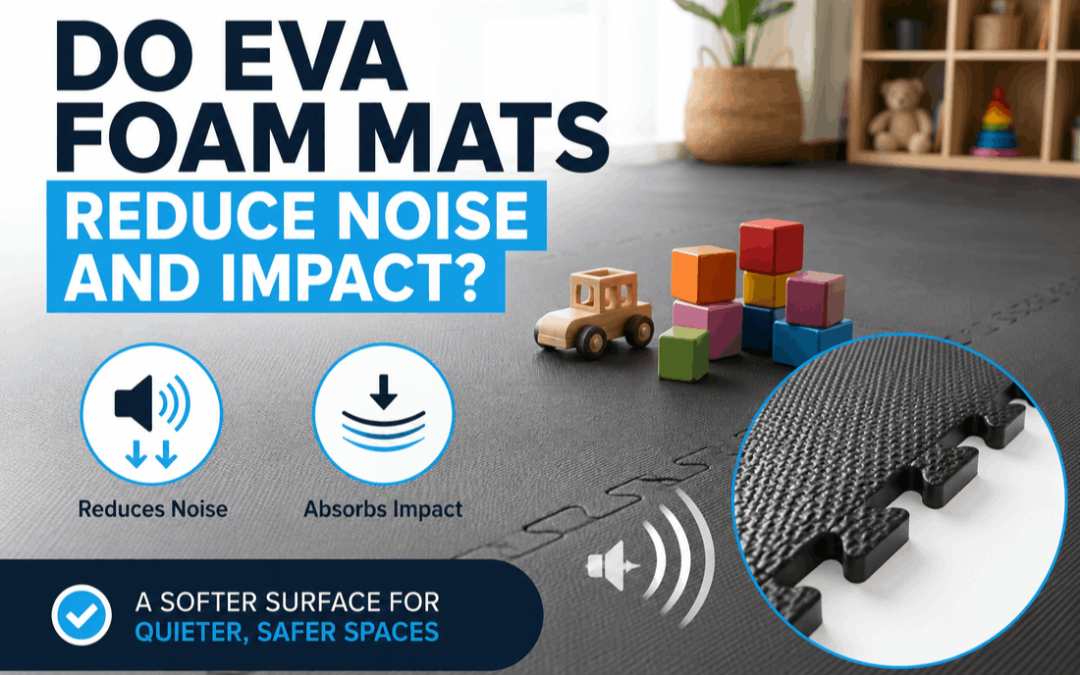
Do EVA foam mats reduce noise in playrooms, classrooms, home activity rooms and light exercise spaces? They may soften certain sounds created when feet, toys or lightweight accessories make contact with a hard floor. Their cushioned foam structure can reduce the sharpness of light impacts and create a less harsh surface than bare ceramic tiles, concrete, laminate or timber. However, ordinary EVA tiles should not be marketed as complete soundproofing, acoustic insulation or tested heavy-impact protection unless the exact product has supporting acoustic data. For soft modular flooring designed for dry indoor activities, explore our EVA Foam Mats collection.
Do EVA Foam Mats Reduce Noise?
EVA foam mats may reduce some light contact and impact noise by cushioning the point where an object, foot or toy meets a hard floor. They can make footsteps, building toys, exercise accessories and controlled floor movements sound less sharp. Their effect depends on mat thickness, firmness, coverage, the original floor and the type of sound. EVA does not normally block voices, music, televisions or significant noise passing through walls, ceilings and building structures.
Light impact cushioning
Foam can soften contact between lightweight objects and a hard floor during ordinary indoor activities.
Comfort during movement
A cushioned surface can feel less harsh during walking, kneeling, stretching and controlled floor exercise.
Defined quiet zones
Interlocking tiles can create a softer reading, play or activity section without covering the complete room.
Understanding Noise, Impact and Vibration
Not every unwanted sound is created in the same way. Understanding the source of a noise helps determine whether foam flooring is likely to make a noticeable difference.
Impact noise
Impact noise begins when two surfaces make physical contact. Examples include a toy falling onto the floor, footsteps across hard tiles, a lightweight dumbbell being placed down carefully or a chair leg touching the surface.
This is the type of sound that a cushioned floor is most likely to soften because the foam sits directly between the object and the hard substrate.
Airborne sound
Airborne sound travels through the air before reaching walls, doors, ceilings and other surfaces. Voices, music, televisions and barking dogs are common examples.
Floor mats alone are unlikely to stop these sounds from travelling through the room or entering neighbouring rooms. Walls, doors, windows, ceilings and gaps may play a much larger role.
Structure-borne vibration
Some equipment transfers repeated movement through the floor and building structure. Treadmills, large speakers, machinery and heavy exercise equipment can produce more demanding vibration than ordinary floor activities.
Lightweight EVA puzzle mats are not automatically suitable vibration-isolation products for heavy equipment. A purpose-made machine mat, dense rubber flooring or an engineered solution may be required.
How EVA Foam May Affect Contact Sound
A bare hard floor does not compress significantly when a lightweight item makes contact with it. Much of the contact happens suddenly, producing a sharper and more noticeable sound.
EVA foam compresses under light pressure. This can slightly increase the time over which contact takes place and soften the immediate impact between the object and the floor.
The result may be a less harsh sound from light footsteps, plastic toys, building blocks, stretching accessories and other controlled activities.
The amount of change will not be the same in every room. It depends on:
- The thickness of the foam.
- The firmness and density of the mat.
- The total floor area covered.
- The weight and shape of the object.
- The height from which an object falls.
- The original floor material.
- The construction of the building.
- The position of neighbouring rooms.
- The amount of furniture and other soft material.
- Whether the noise is impact, airborne or vibration-related.
This is why broad promises about exact noise reduction should be avoided unless a flooring product has been tested under a stated standard and installation method.
7 Powerful Benefits of EVA Foam for Light Indoor Noise and Impact
Softens the sound of light footsteps
Walking barefoot or in soft indoor shoes across EVA may sound less sharp than walking directly across ceramic tiles, laminate or concrete. This can be useful in children’s rooms, reading corners and light activity spaces.
The mats will not eliminate all footsteps, particularly in buildings where movement travels through the floor structure.
Cushions lightweight toys and play accessories
Building blocks, plastic toys and activity accessories can create repeated tapping sounds on hard floors. A foam layer may soften these contacts during supervised play.
Sharp, heavy or unsuitable objects should still be kept away because they can cut or permanently compress the foam.
Reduces the harsh feel of floor exercises
Hands, knees, feet and light fitness accessories make repeated contact with the floor during stretching, mobility work, yoga and controlled bodyweight exercises.
EVA creates a cushioned activity surface that may make these contacts feel and sound less abrupt than the original hard floor.
Creates a defined soft activity zone
Instead of covering a complete room, interlocking tiles can define the section where toys, reading or stretching takes place.
Concentrating suitable floor activities onto the softer zone may help reduce repeated hard contact elsewhere in the room.
Helps protect the original floor from light contact
The foam forms a separating layer between lightweight objects and the substrate. This may help reduce ordinary marks associated with controlled floor-level use.
EVA should not be treated as protection against dropped weights, sharp tools, heavy machines or extreme impact.
Provides modular coverage
Individual tiles can be added, removed or replaced as room requirements change. This makes it possible to extend the cushioned area around suitable activities without permanently altering the full floor.
Compatible tiles with the same thickness and puzzle pattern should be used when expanding the installation.
Adds everyday floor comfort
Noise reduction is not the only reason to select EVA. The material can also create a softer surface for sitting, kneeling, crawling, stretching and light indoor movement.
This combination of cushioning and modular installation makes EVA practical for suitable home, school and community activity areas.
What Sounds Can EVA Foam Mats Help Soften?
EVA may help soften
- Light barefoot footsteps.
- Controlled floor exercises.
- Plastic toys touching the floor.
- Building blocks used in play areas.
- Light stretching accessories.
- Carefully placed exercise equipment.
- Kneeling and crawling activities.
- Small everyday contact sounds.
- Movement in reading and play corners.
- Light chair contact where the product is suitable.
EVA is unlikely to solve
- Loud voices or music.
- Television sound through walls.
- Traffic noise entering windows.
- Heavy treadmill vibration.
- Commercial machinery noise.
- Dropped barbells and heavy weights.
- Structural noise between building levels.
- Noise passing through doors and gaps.
- Large speaker vibration.
- Whole-room acoustic or echo problems.
EVA foam is not complete soundproofing
Soundproofing normally requires a coordinated approach involving the floor, walls, ceiling, doors, windows, gaps and building structure. A removable foam mat is only one possible surface treatment.
Does Mat Thickness Improve Noise Reduction?
A thicker mat may provide more material between a light object and the hard floor, but thickness alone does not guarantee better acoustic performance.
Foam firmness and density influence how the product compresses. A very soft thick tile may respond differently from a firmer tile with the same stated thickness.
The following features should be assessed together:
- Thickness in millimetres.
- Foam firmness and density.
- Surface texture.
- Tile dimensions.
- Puzzle-joint quality.
- Total coverage area.
- Original floor construction.
- The type and weight of the impact.
- The manufacturer’s intended application.
- Available acoustic or impact test information.
A 12mm EVA mat can provide comfortable cushioning for many light indoor activities, but it should not automatically be assigned a decibel reduction or impact rating without a relevant report.
EVA Foam Compared With Other Flooring Materials
| Flooring Type | Light Contact Noise | Best Application | Important Limitation |
|---|---|---|---|
| EVA foam mats | May soften light footsteps and floor contact | Playrooms, stretching and light activity areas | Not complete soundproofing or heavy-impact flooring |
| Rubber flooring | Generally better suited to heavier impact and equipment | Gyms, machine areas and demanding activity zones | Heavier, firmer and less portable than EVA |
| Carpet with underlay | Can soften footsteps and some contact sounds | Bedrooms, offices and quiet rooms | Spills may require deeper cleaning |
| PVC interlocking tiles | Provides firm modular flooring | Busy multipurpose and commercial rooms | Less cushioned than EVA foam |
| Ceramic tiles | Hard surface may produce sharper contact sounds | Permanent firm and washable floors | Limited cushioning for floor-level activities |
| Purpose-made acoustic underlay | Designed for a stated floor assembly | Projects requiring measured acoustic performance | Results depend on the complete tested installation |
When comparing whether EVA foam mats reduce noise, remember that the answer depends on the sound source. EVA is strongest for light surface contact, while heavier loads and measured building-acoustic requirements need more specialised materials.
Best Rooms for Noise-Reducing EVA Foam Mats
Children’s playrooms
Foam can soften ordinary contact from plastic toys, building blocks and supervised floor movement while creating a more comfortable activity surface.
Kids bedrooms
A selected mat section can form a reading or play corner without placing heavy beds and cupboards on the foam.
Classrooms and crèches
EVA may suit reading areas, floor learning, supervised play and other light activities where children sit or kneel near the floor.
Home stretching rooms
The mats can cushion controlled yoga, Pilates, mobility exercises and bodyweight movements.
Community activity spaces
Temporary foam zones may support children’s programmes, gentle movement sessions and reading groups inside multipurpose halls.
Upstairs activity areas
EVA may soften some light contact at the surface, but it cannot guarantee that sound will not travel to the room below. Building construction plays a major role.
How to Improve the Result
Identify the exact sound source
Determine whether the problem is footsteps, toys, voices, music, exercise equipment or building vibration.
Use EVA only for suitable activities
Place light play, reading, stretching and controlled floor exercise on the foam section.
Cover the full activity footprint
The mat should extend across the area where appropriate contact normally takes place rather than covering only a small unrelated corner.
Prepare a clean and level base
Dust, debris and uneven flooring can affect the finished installation and cause puzzle joints to separate.
Connect all joints properly
Press the puzzle edges evenly and inspect the outside perimeter before the area is used.
Reduce avoidable impacts
Do not drop objects unnecessarily. Place toys and light equipment down carefully and keep unsuitable heavy items away from EVA.
Assess the complete room
Furniture, curtains, doors, windows, wall construction and ceiling design may also influence how sound behaves.
Practical tip: Test a small mat section in the actual room before ordering a large quantity. Listen from the room itself and, where relevant, from the adjoining space below or beside it.
Official Guidance on Impact and Noise Control
Noise management works best when the source, transmission path and receiving area are considered together.
The external CDC/NIOSH guidance on engineering noise controls discusses methods such as reducing impact noise and adding sound-absorbing materials as part of broader noise-control planning.
This guidance relates mainly to occupational noise control, but the underlying principle remains useful: identify how the sound is created before selecting a material.
A foam floor may help with light surface impact, but it cannot replace barriers, isolation, building work or specialised acoustic treatment when the noise travels through walls, ceilings or structural components.
Avoid Unsupported Acoustic Claims
Do not advertise an exact decibel reduction, impact-insulation rating, soundproofing level or shock-absorption percentage unless the claim is supported by testing for the exact mat and installation method.
Safer wording includes “may soften light impact noise”, “provides a cushioned surface” and “helps reduce the harsh sound of ordinary floor contact”.
Can EVA Mats Reduce Exercise Noise?
EVA may soften light sounds associated with stretching, yoga, Pilates, mobility work and controlled bodyweight exercise.
Hands, knees and feet contact the cushioned surface rather than the original hard floor. Light accessories can also be placed down carefully on the mats.
The material should not be used as a solution for dropped weights, power racks, heavy benches, treadmills or commercial exercise machines.
These activities create higher loads, concentrated pressure and stronger vibration. Dense rubber gym flooring or a purpose-made equipment mat is normally more appropriate.
Do not stack several soft foam layers beneath a machine in an attempt to improve noise control. Excessive softness may affect equipment stability.
Does EVA Reduce Noise Between Floors?
EVA may reduce some light contact at the surface, which could make particular footsteps or toy sounds less sharp. However, it cannot guarantee privacy or silence in the room below.
Sound transmission between levels depends on the concrete slab or timber floor, ceiling system, joists, gaps, finishes and connection between structural components.
A building with poor sound separation may require an acoustic underlay, ceiling treatment, resilient channels or another professionally designed system.
Where measured performance is required, consult an acoustic professional and request test data for the complete proposed floor assembly.
Cleaning and Maintaining the Mats
Dirt, damaged joints and trapped moisture can affect the appearance and practical use of the floor.
Remove loose dirt regularly
Sweep or vacuum dust, hair, crumbs and sand using equipment suitable for the foam surface.
Use controlled moisture
Wipe the tiles with a soft cloth or damp mop and a mild cleaner approved for the product.
Avoid flooding the joints
The interlocking connections are not necessarily watertight. Liquid can reach the permanent floor underneath.
Lift tiles after larger spills
Clean and dry both the foam and the substrate before reconnecting affected pieces.
Inspect the puzzle edges
Replace tiles that have split, stretched or missing connections. Loose joints may create movement during activity.
Keep spare pieces
Store compatible replacement tiles flat, clean and dry so damaged areas can be repaired more easily.
Common Mistakes to Avoid
Calling EVA completely soundproof
Ordinary puzzle mats do not prevent all sound from travelling through a room or building.
Expecting foam to stop voices or music
Airborne sound may require treatment of doors, walls, windows, ceilings and gaps.
Using EVA beneath heavy machines
Concentrated loads and vibration may compress the foam and affect machine stability.
Dropping weights onto soft play mats
EVA intended for play and light exercise is not heavy-impact weight-room flooring.
Choosing thickness alone
Firmness, density, intended use and the original floor are also important.
Installing over an uneven surface
Debris and raised sections may prevent the tiles from lying correctly.
Making exact acoustic claims without testing
Performance figures should come from documentation that applies to the exact product and construction.
EVA Noise and Impact Flooring Checklist
- Identify whether the sound is impact, airborne or vibration-related.
- List the activities taking place in the room.
- Use EVA mainly for light indoor floor activities.
- Confirm the material and intended application.
- Compare mat thickness and firmness.
- Check each tile’s dimensions and pack coverage.
- Measure the complete activity footprint.
- Prepare a clean, dry and stable substrate.
- Connect every puzzle joint properly.
- Keep heavy machines and weights off the foam.
- Avoid unsupported soundproofing claims.
- Request test information for measured acoustic performance.
- Manage spills before moisture reaches several joints.
- Inspect the floor for compression and damage.
- Test a small section in the actual room where possible.
- Consider professional advice for building-wide noise problems.
Frequently Asked Questions
Do EVA foam mats reduce noise?
They may soften light contact sounds such as footsteps, toys and controlled floor exercises, but they do not provide complete soundproofing.
Do EVA mats absorb impact?
The foam can cushion light ordinary contact. It should not be treated as heavy-impact protection unless the exact product is tested for that purpose.
Will EVA stop noise from reaching downstairs?
It may soften some light surface contact, but the building’s floor and ceiling construction determine how much sound reaches the level below.
Are thicker foam mats quieter?
They may provide more cushioning, but firmness, density, coverage and the type of impact also influence the result.
Can EVA reduce toy noise?
It may make the sound of lightweight plastic toys and building blocks less sharp than contact with bare tiles or concrete.
Do EVA mats reduce voices and television noise?
Not significantly. These are mainly airborne sounds and may require treatment of walls, doors, windows or ceilings.
Can EVA reduce treadmill vibration?
Ordinary soft EVA is generally not the best choice beneath a heavy treadmill. Use a purpose-made machine mat or suitable dense gym flooring.
Are EVA mats suitable beneath weights?
They may suit light accessories placed down carefully, but they are not intended for dropped weights or heavy lifting zones.
Can EVA be installed over ceramic tiles?
It can generally be installed over tiles that are clean, dry, stable and free from sharp or raised sections.
Do EVA mats need glue?
Many puzzle-style products are designed for loose-lay installation. Follow the instructions supplied with the exact product.
Are EVA mats acoustically tested?
Some products may have test data, but this should never be assumed. Request documentation for the exact mat and installation.
What flooring is better for heavy impact?
Dense rubber tiles or an engineered impact flooring system are generally more suitable for machines, racks and weight-training areas.
Final Advice: Do EVA Foam Mats Reduce Noise and Impact?
Do EVA foam mats reduce noise? They may make light floor contact less sharp by cushioning footsteps, toys, stretching accessories and controlled indoor movement.
The mats are most useful in playrooms, children’s bedrooms, classrooms, reading corners, stretching areas and other dry indoor spaces where light activities take place close to the floor.
EVA should not be presented as complete soundproofing. It is unlikely to stop voices, music, outdoor traffic or substantial sound travelling through walls, ceilings and building structures.
Thickness can influence cushioning, but firmness, density, room coverage, impact weight and the original floor also matter. Avoid assigning an acoustic rating or exact decibel reduction without supporting test information.
For heavy machines, commercial equipment, racks and dropped weights, select denser rubber flooring or a purpose-made system designed for the application.
Prepare the original floor so it is clean, level and dry. Connect all puzzle joints correctly and inspect the mats regularly for separated edges, permanent compression and moisture.
When used within their intended limits, EVA mats can provide a softer, more comfortable activity surface while helping to reduce the harshness of ordinary light impact sounds.
Create a Softer Indoor Activity Surface
Measure your room, identify the activities and compare lightweight interlocking foam flooring for playrooms, classrooms, stretching zones and other dry indoor spaces.
View EVA Foam Mats