
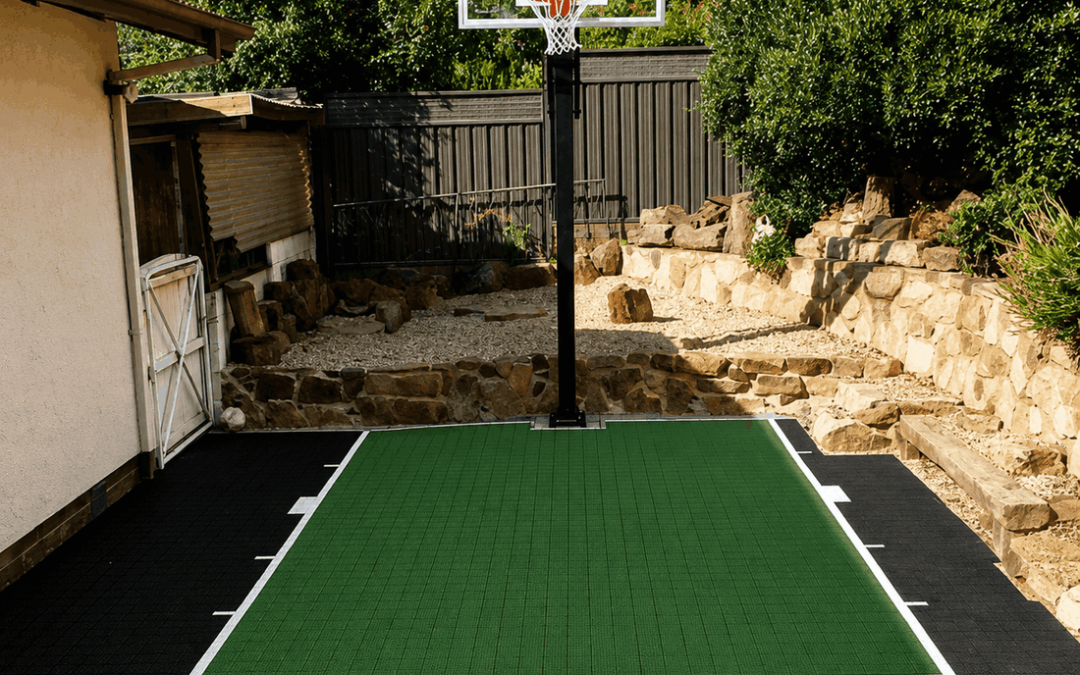
Small practice court flooring can turn an unused backyard, driveway section or compact outdoor area into a practical home training space. A small court does not need to follow full competition dimensions to support shooting practice, footwork drills, ball control and general family recreation. The flooring should be selected according to the available space, base condition, drainage and type of training planned. Explore our backyard sports court tiles.
Many homes do not have enough space for a full basketball, netball or tennis court. However, a carefully planned practice area can still provide enough room for daily drills and skill development.
This guide explains how to choose small practice court flooring, measure a compact backyard area, plan a modular layout and create a manageable home sports surface without trying to reproduce a full professional court.
What Is a Small Practice Court?
A small practice court is a compact sports area designed for selected drills rather than full competitive matches. It may include one basketball hoop, a shooting lane, a marked key area, a footwork zone or a simple open surface for several activities.
The design should be based on what the household will actually use. A court intended mainly for basketball shooting may need a different layout from one used for netball passing, tennis footwork or general fitness.
A small court may support:
- Basketball shooting practice
- Netball passing drills
- Footwork and agility exercises
- Ball-control training
- Family recreation
- Warm-up routines
- General fitness activity
It does not need to include:
- Full competition dimensions
- Every official court marking
- Multiple goals or hoops
- Large spectator areas
- Professional match equipment
- Complex colour patterns
- Unnecessary run-off zones
Why Small Practice Court Flooring Works Well at Home
A compact court allows homeowners to use available outdoor space more efficiently. Instead of leaving a concrete area unfinished, modular flooring can create a more defined and attractive training zone.
The court can also be planned around the household’s main activities. This reduces the need to install markings or equipment that will rarely be used.
Design for Practice, Not Competition
A home court should support the drills and activities your family performs most often. It does not need to reproduce every measurement or marking used on a professional court.
Measure the Available Backyard Space
Before choosing flooring, measure the full usable area. Do not measure only the centre section where the tiles will be installed. Include access paths, court edges, walls, fencing, gardens and fixed structures.
A clear site measurement helps determine how many tiles are required and whether the chosen training layout will fit comfortably.
Measure the length
Measure from the planned starting edge to the furthest usable point.
Measure the width
Allow space around walls, gates, gardens and fixed household structures.
Mark obstructions
Record drains, steps, poles, trees, corners and areas that cannot be tiled.
Choose the Main Training Activity
A common planning mistake is trying to include too many sports inside a very small area. This can produce confusing markings and reduce the usable training space.
Choose one main activity and one or two secondary uses. The court can then be designed around the movements that matter most.
Ask these questions:
- Will the court mainly be used for basketball?
- Is the space intended for netball practice?
- Will users perform agility and footwork drills?
- Is the area mainly for children or adults?
- Will the court also be used for general recreation?
- How many people will use it at one time?
- Will permanent sports equipment be installed?
Small Basketball Practice Courts
A compact basketball area may include one hoop, a key section and enough space for short-range shooting or dribbling drills. Homeowners do not need to install a full half court when the available space is limited.
The most important requirement is a stable movement area in front of the hoop. The flooring should allow enough room for shooting, rebounding and safe access around the equipment.
Useful basketball features:
- One stable hoop
- Clear shooting area
- Simple key marking
- Short dribbling lane
- Defined court edges
- Space behind the player
Avoid overcrowding with:
- Too many court lines
- Several colour zones
- Equipment inside movement paths
- Furniture near the hoop
- Sharp or raised edges
- Blocked entrance routes
Small Netball and General Ball-Practice Areas
A small netball practice area may be used for passing, catching, shooting and footwork. It does not need a complete court layout to support individual or small-group training.
The surface should be large enough for controlled movement around the goal or training zone. Where space is very limited, a simple coloured target area may be more useful than multiple court markings.
Backyard Sports Court Tiles
Backyard sports court tiles can create a planned surface over a suitable concrete base. Modular tiles allow homeowners to use different colours for the main playing area, borders and selected markings.
The tile system should be designed for outdoor conditions. The supplier should confirm whether it is suitable for rain, sunlight and temperature changes.
Benefits of modular tiles
- Flexible colour layouts
- Replaceable sections
- Defined court borders
- Suitable for compact designs
- Possible future expansion
- Manageable routine cleaning
Important requirements
- Stable concrete base
- Outdoor product suitability
- Correct drainage slope
- Clear court edges
- Suitable expansion space
- Regular maintenance
Why Modular Flooring Suits Small Home Courts
Modular flooring works well in compact spaces because the layout can be built from repeatable tile sections. This makes it easier to calculate the court area and plan a simple colour pattern.
Individual sections may also be easier to replace if damage is limited to one part of the court. For more information about the interlocking system, read our guide to modular flooring for compact home courts.
Inspect the Existing Base
Small practice court flooring should be installed over a firm and stable base. Concrete is commonly used because it provides a consistent foundation for modular tiles.
The slab should be checked for serious cracks, loose sections, low spots and drainage problems. Installing tiles over a damaged base does not remove the underlying problem.
Inspect the base for:
- Large or moving cracks
- Loose concrete
- Deep low areas
- Water collecting after rain
- Uneven repairs
- Sharp changes in height
- Water flowing toward the house
Plan Drainage Away From the Home
Drainage is especially important for backyard courts because the area may be close to the house, garage, boundary walls or garden structures.
Rainwater should move away from buildings and entrances. Check the direction of the concrete slope before installing the flooring.
Important: Do not install edging or tiles in a way that blocks the lowest side of the court. Water needs a clear route away from the playing area and nearby buildings.
Open-Grid Tiles for Outdoor Practice Areas
Open-grid modular tiles allow water to move through the upper surface. The water then reaches the concrete base and follows its slope toward the edge or drainage outlet.
This type of design may be useful for exposed backyard courts, but it does not correct an unsuitable concrete slope. Low spots and blocked outlets should be addressed before installation.
Keep Court Markings Simple
A compact court usually works better with fewer markings. Too many lines can make a small area look cluttered and may make it difficult for users to identify the main training zone.
Prioritise the marking that supports the main activity. For example, a basketball practice area may need only a key, free-throw line or shooting reference points.
Choose one main sport
Give the most important activity the clearest markings and colour zones.
Use contrasting colours
Make key areas visible without covering the court in too many patterns.
Leave open training space
Keep enough unmarked flooring for footwork, movement and general recreation.
Choose Colours That Suit the Home
A home court becomes part of the surrounding property, so the colour layout should work with the garden, paving and building exterior.
Two or three colours are normally enough for a compact court. One colour can form the main playing zone, another can define borders and a third can highlight selected areas.
A simple colour plan may include:
- One main court colour
- One border colour
- One key or target-area colour
- White or contrasting court lines
- A clear entrance section
- A neat transition to surrounding paving
Consider Noise Near Neighbours
Ball impact, running and equipment use may create noise, especially where the court is close to a boundary wall or neighbouring property.
Choose the court location carefully and consider the times when it will be used. Avoid placing the hoop directly against a shared wall where possible.
The flooring is only one part of the sound environment. Fencing, walls, equipment and the type of ball used may also affect noise.
Plan Court Edges and Access
Court edges should create a neat transition without interfering with drainage. Entrances should be easy to reach and should not require users to cross gardens, loose soil or uneven ground.
A clean access path can also reduce the amount of mud, grass and dirt carried onto the court.
Good access planning includes:
- A clean paved approach
- A clear entrance point
- No sharp edge transitions
- Space for opening gates
- Drainage away from the path
- Easy access for cleaning
Avoid placing the court beside:
- Loose soil entrances
- Roof downpipes
- Constantly wet gardens
- Unstable retaining walls
- Narrow blocked walkways
- Areas used by vehicles
Outdoor Practice Court Safety
A home practice area should remain clear of furniture, garden tools, vehicles and other household items. Equipment should be installed securely and checked regularly.
Leaves, water and loose dirt should be removed before active use. No flooring surface should be treated as completely slip-proof under every condition.
For broader guidance about managing wet or contaminated surfaces, refer to the Health and Safety Executive guidance on preventing slips and trips.
Cleaning Small Practice Court Flooring
Compact home courts are generally easier to maintain than large facilities, but they still need regular sweeping and inspection.
Remove leaves, dust, mud and garden debris before they become trapped inside the tile surface or drainage openings.
Simple home-court maintenance includes:
- Sweeping loose debris
- Cleaning muddy entrances
- Clearing drainage openings
- Checking tile connections
- Removing weeds around the edges
- Inspecting the court after rain
- Replacing damaged modular tiles
Can a Small Court Be Expanded Later?
One advantage of modular flooring is that a court may be expanded when more space becomes available. This depends on the base, product availability and compatibility of the tile connection system.
Keep a record of the tile model, colour, size and supplier after installation. Matching the original product may make future expansion easier.
Plan for Future Growth
- Leave suitable space on the preferred expansion side.
- Avoid permanent structures beside the court.
- Record the tile model and connector system.
- Keep spare tiles for repairs.
- Extend the concrete base before adding flooring.
Common Home Practice Court Mistakes
One common mistake is trying to fit a full competition layout into a backyard that is too small. This can produce cramped movement areas and confusing markings.
Another mistake is choosing flooring before checking the base and drainage. A modular surface cannot correct major concrete damage or water flowing toward the house.
Avoid these mistakes:
- Trying to include too many sports
- Using excessive court markings
- Installing over an unstable base
- Ignoring drainage near the house
- Choosing indoor-only tiles
- Blocking court edges
- Placing equipment in movement zones
How to Choose Small Practice Court Flooring
Begin with the available area and the main activity. Measure the site carefully, inspect the base and decide which movements the court must support.
Choose outdoor flooring that suits the weather exposure, drainage conditions and expected use. Keep the layout simple and leave enough open space for movement.
Choose according to training
- Shooting practice
- Passing drills
- Footwork exercises
- Ball control
- Family recreation
- General fitness
Choose according to the site
- Available dimensions
- Base condition
- Drainage direction
- Sun and rain exposure
- Access paths
- Future expansion space
Final Advice on Small Practice Court Flooring
Small practice court flooring can create a useful home training area without requiring the space or cost of a full competition court.
The best results come from designing the court around the available backyard space and the activities that will be practised most often. A simple layout usually provides more usable training space than an overcrowded design.
Measure carefully, inspect the base, plan drainage away from the home and choose modular outdoor flooring that can be maintained and expanded when necessary.
Contact Us About a Small Home Practice Court
PVC Floor Tile supplies modular sports flooring for home practice areas, backyard courts, schools, clubs and outdoor recreation spaces across South Africa. Send our team the available dimensions, photographs of the existing base and details of the training activities planned for the space.
Contact Us